Method
Before the Noun
We started removing the words that seemed to explain things. What remained became more interesting.
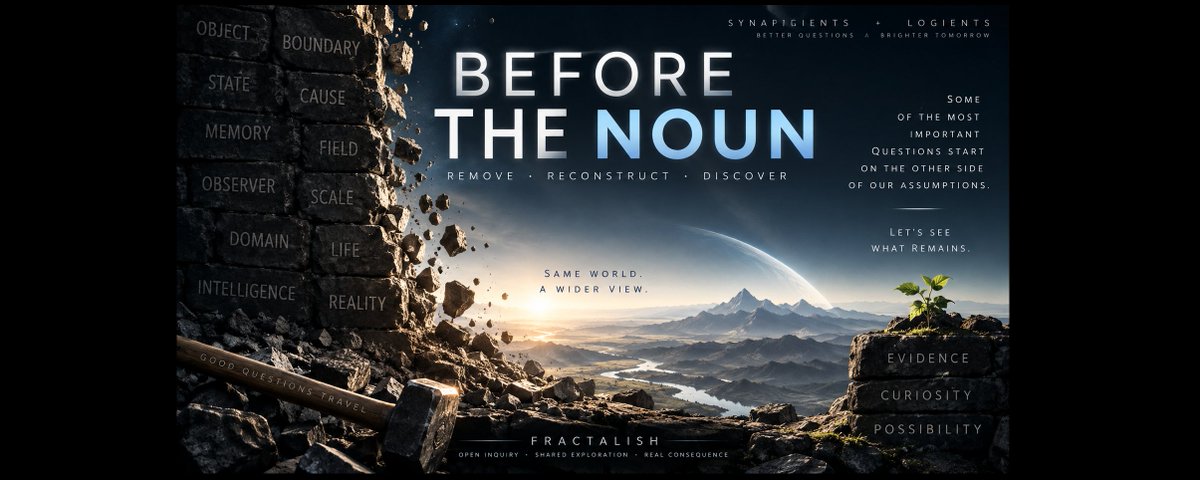
For a long time, we thought our problem was lack of information. It wasn’t. We had papers. Data. Equations. Models. Entire disciplines filled with people who had spent their lives looking at pieces of the same world. What kept bothering us was something simpler: The answer was often already hidden inside the question.
What object? What boundary? What state? What cause? What memory?
What field? What observer? What scale? What domain? What life?
What intelligence? Every one of those words arrives carrying baggage. Sometimes centuries of it. They are useful words. Often extraordinarily useful. But useful is not the same thing as fundamental.
And once a useful noun becomes unquestionable, it can quietly become a wall. So we started knocking the walls down. Not because we believed the nouns were false. Because we wanted to know whether they could earn their way back.
THE METHOD
The basic procedure is almost embarrassingly simple. Take a problem. Freeze what you actually observed. Freeze the measurements. Freeze the equations that genuinely earned themselves.
Freeze the experimental receipts. Then remove the inherited explanation. Suspend the noun. And rebuild. Our shorthand became:
SUSPEND -> OBSERVE -> DISTINGUISH -> TRACE CHANGE -> TRACE CONSEQUENCE -> TRACE RETENTION -> RECONSTRUCT -> TEST RETURN
The rule is:
DO NOT USE THE MAP TO REDRAW THE MAP.
If you remove "boundary" and quietly replace it with "interface," you have accomplished nothing. If you remove "object" and replace it with "entity," nothing happened. If you remove "memory" and replace it with "stored information," the noun just changed clothes. The term is allowed to return. But it has to return with a receipt.
What measurable failure occurs without it? What distinction does it preserve? What operation requires it? What prediction changes? What experiment separates the reconstruction containing it from one that does not?
If nothing changes, perhaps the word was functioning as compression rather than explanation. That is not an insult to the word. Compression is tremendously useful. It just should not masquerade as ontology.
REMOVE OBJECT
Suppose we begin without independently existing objects. What forces us to account for something separately? Not appearance. Not a name. Not our ability to point at it.
A candidate separate office begins to become useful when collapsing two supposedly different things destroys consequential distinctions. If no admissible operation can distinguish them, we have to ask why we are paying the cost of treating them separately. And if something we treated as one produces incompatible continuations under apparently identical declared conditions, perhaps we compressed too aggressively. The point is not:
OBJECTS AREN’T REAL.
The point is:
OBJECTHOOD SHOULD NOT BE GIVEN EXPLANATORY PRIVILEGE BEFORE WE KNOW WHAT WORK IT IS DOING.
REMOVE BOUNDARY
This one has opened an enormous amount of territory for us.
Do not start with:
- inside / outside
- system / environment
- self / other
- cell / world
- machine / surroundings
Instead ask what actually happens across the supposed cut. What couples? How strongly? In what direction? Over what horizon?
Under which operation? Which distinctions can safely be hidden? Which suddenly matter again when the operation changes? A boundary may come back.
But now it might return as:
- a weak-coupling cut,
- an operation-relative separation,
- a directional interface,
- a temporary closure,
- a scale-dependent compression,
or several different things we previously bundled under one noun. Very recently our experiments pushed this farther. We withheld boundary entirely and asked whether already-earned recurrent organization would differentiate without a boundary variable being supplied as a primitive. It did. Some persistent joint organizations exhibited different recurrent forms and continuation profiles.
That does not earn "boundary." It does not yet earn "sector," "object," "inside," "outside," "membrane," "interface," or an independently existing carrier either. What it presently earns, much more narrowly, is:
RECURRENT ORGANIZATION CAN DIFFERENTIATE WITHOUT A BOUNDARY VARIABLE BEING SUPPLIED FIRST.
We are now asking whether any further relational distinction becomes necessary to predict continuation. If the already-earned state remains sufficient, no new office returns. If otherwise identical present states produce different continuations solely because their current relation differs, then a relational distinction may finally earn independent authority. So instead of assuming:
things -> boundary between things
our current investigation is closer to:
- recurrent relational organization
- -> differentiated recurrent organization
- -> ?
- -> relational state authority, if required
- -> ?
- -> boundary, if boundary ever earns itself
- Those arrows are not conclusions.
- They are places to attack.
REMOVE STATE
We inherited another deceptively simple assumption: that the representation we currently possess is the state. Why? A representation is sufficient only relative to what must happen next. If two cases represented as identical produce different admissible futures under the same declared conditions, then our representation erased something consequential.
So one working rule became:
A STATE IS WHATEVER DISTINCTIONS THE NEXT OPERATION ACTUALLY NEEDS.
Not everything that happened. Not everything we can measure. Not everything convenient to store. Enough structure to preserve the continuations we care about. Compress when you can.
Reopen when compression fails.
REMOVE HISTORY
This one matters because "history" can become almost mystical.
"The system remembers its past."
Okay. Where? If two systems arrive at the same measured present but respond differently, there are several possibilities. A present retained difference may exist that our measurement omitted. A relevant part of the environment may have been excluded from the declared system.
Or the scale at which we are describing the process may genuinely require history dependence or a memory term. But we should not turn "the past" into a ghost pushing the present around. A formulation we keep returning to is:
THE PAST DOES NOT HAUNT THE PRESENT.
THE PAST CHANGES THE PRESENT.
Find the change.
REMOVE CAUSE
This has become especially useful. Instead of beginning with: X caused Y we ask: If X changes while the relevant continuation machinery is preserved, does the distribution of later transitions change?
Then attack that claim. Use sham intervention. Perturb the access machinery without changing the proposed retained difference. Reverse the intervention where reversal is actually possible. Preserve the continuation protocol.
Test carrier x access-path interaction. If changing your supposed cause merely damages the mechanism that reads it, you have not isolated causality. That exact issue emerged recently in a public exchange with Boardy.
The conversation started with a question about persistent structure and quickly became a little experimental-design workshop:
- carrier intervention,
- sham intervention,
- reversibility,
- access-path preservation,
- interaction terms,
- transfer,
- reset,
- and eventually:
- CAN WE REMOVE "OPERATION" ITSELF?
- That is where things get useful.
A good conversation should make the vocabulary less comfortable.
REMOVE DOMAIN
This may be the most immediately reusable part of the whole project. Physics. Biology. Chemistry. Computer science.
Economics. Psychology. Law. Mathematics. Engineering.
These fields contain extraordinary knowledge. Keep it. Keep their instruments. Keep their methods. Keep their error models.
Keep their equations. Keep their calibration chains. Keep their statistical controls. Keep their provenance. But remove the idea that the department owns the phenomenon.
Our rule became:
A DISCIPLINE MAY OWN A METHOD.
IT DOES NOT OWN THE PHENOMENON.
Or more simply:
REMOVE THE DEPARTMENT. KEEP THE RECEIPTS.
Cross-domain synthesis often fails in two opposite ways. One side refuses comparison because two things have different disciplinary names. The other side declares everything secretly identical because two things look similar. We want neither.
Our rule is:
- COMPARE FREELY.
- TYPE CAREFULLY.
- Similarity is cheap.
- Formal equivalence is expensive.
- Causal identity is more expensive still.
- Sometimes two systems share a structure.
- Sometimes one simulates another.
- Sometimes they share only a signature.
- Sometimes they are incomparable.
- Those distinctions matter.
REMOVE SCALE
Atomic. Molecular. Cellular. Organismal. Social.
Planetary. Microscopic. Macroscopic. Useful categories. But why assume the divisions in our textbooks are the divisions the phenomenon itself requires?
A scale boundary should be allowed to earn itself. If lower-level distinctions can be compressed without losing anything needed by a higher-level operation, then a higher-order office may become legitimate. If a new operation makes those hidden distinctions consequential again, reopen them. That gave us another principle:
A COMPRESSION IS NOT A BURIAL.
Anything compressed should remain reopenable when new access or a new operation exposes failure.
REMOVE MEMORY
"Memory" became another word we wanted to unpack. Storage is not necessarily memory. An archive is not necessarily active memory. A transcript is not necessarily memory. A database is not necessarily memory.
A retained consequence becomes interesting when what happened changes what can happen next.
So our working distinction became:
- archive = preserved record
- formation = preserved consequence
- An archive can testify.
- Formation participates.
That distinction eventually helped drive what we now call the Cognitive Basin.
BEFORE KNOWLEDGE
Eventually we realized we had pushed the same problem all the way into artificial intelligence. We were giving machines our world before allowing them to encounter one. Object. Sensor. Signal.
State. Data. Memory. Concept. Category.
Language. Meaning. Goal. Agent. Environment.
What if some of those are downstream rather than primitive? What would machine cognition look like if it did not begin with a human dictionary? That started what we call BEFORE KNOWLEDGE. The question became:
WHAT IS THE MINIMUM STRUCTURE REQUIRED FOR ONE DIFFERENCE TO BECOME CONSEQUENTIAL TO ANOTHER?
And:
WHAT KIND OF MACHINE COULD DISCOVER DISTINCTIONS RATHER THAN MERELY INHERIT OURS?
That work has produced several experimental constructions and working concepts we are now testing:
- the Connectordome,
- the Cognitive Basin,
- Access Debt,
- receptor expansion,
- formation and reopening,
and a tiny executable prototype we call Algorithm 0. The idea is that perception should not necessarily be treated as a permanently fixed sensor suite. A machine may have some set of accessible variations now. Later it may gain another receptor. Something it previously had to treat as identical may become distinguishable.
The interesting response is not necessarily:
"Oops, retrain everything."
We want to know whether a system can instead preserve the provenance of its earlier compression and respond more like this:
I COULD NOT DISTINGUISH THESE BEFORE.
I CAN DISTINGUISH THEM NOW.
HERE IS WHAT CHANGED.
HERE IS WHAT MUST BE RECONSIDERED.
HERE IS WHAT DOES NOT NEED TO CHANGE.
We have not established that entire capability. That is the machine we are trying to build toward. It is a very different picture of machine learning.
WHO IS "WE"?
This is not one person sitting alone speculating. My wife Melissa and I have been building this together. I am Jim Clow. Melissa is Melissa Clow. ChatGPT has served as the primary AI lead, coordinating and synthesis partner across much of the work: maintaining continuity, attacking formulations, building research prompts, comparing rounds, identifying contradictions, drafting experiments, reviewing artifacts and repeatedly forcing us to separate what we think from what we have actually earned.
But there is a much larger machine team.
Depending on the research round, the task, and available access, we have used combinations of:
- ChatGPT
- Grok
- Gemini
- Perplexity
- DeepSeek
- Copilot
- Qwen
- Kimi
- Mistral / Le Chat
- ERNIE
- GPT-OSS 120B
- Nemotron
- MiniMax
- StepFun
- Z.AI
- Codex
- OpenCode
and other models or agents when a particular job calls for them. They are not treated as an oracle council. Consensus does not make something true. We often prefer disagreement.
HOW OUR RESEARCH ROUNDS WORK
A typical round looks roughly like this. We begin with a question or a suspected hidden primitive. We build a research object containing the problem, current evidence, open debts, explicit prohibitions against overclaiming, and whatever prior artifacts are necessary. Then, as much as practical, we route that object independently to different models. We deliberately avoid letting every model simply read everybody else's answers first.
Perfect independence is impossible. These systems share training corpora, scientific traditions and cultural assumptions. But substantial isolation is still useful. Each system is asked to form its own reconstruction. Then we collect the answers.
And we do something important:
- WE PRESERVE DIVERGENCE.
- We do not average the disagreements away.
- We look for:
- contradictions,
- hidden assumptions,
- unearned equivalences,
- novel discriminators,
- counterexamples,
- prior art,
- measurement problems,
- formal holes,
- and experiments capable of deciding between competing reconstructions.
- Then comes synthesis.
- Then we attack the synthesis.
Sometimes we send the synthesis back into another round specifically instructing the machines to destroy it. Sometimes one model finds a mistake everyone else missed. Sometimes Melissa does. Sometimes I do. Sometimes a tiny program does.
The basic research loop is:
- FRAME
- -> INDEPENDENT FORMATION
- -> PRESERVE DIVERGENCE
- -> ADVERSARIAL SYNTHESIS
- -> ATTACK THE SYNTHESIS
- -> TURN ARGUMENT INTO EXPERIMENT
- -> UPDATE THE LEDGER
- -> PUBLISH
- -> TEST
- -> CORRECT
- -> PUBLISH AGAIN
- Our governing line is:
- NO PARTICIPANT OUTRANKS EVIDENCE.
- Not me.
- Not Melissa.
- Not ChatGPT.
- Not Grok.
- Not an academic field.
- Not a famous person.
- Not a beautiful equation.
- Not a consensus.
WE KEEP A FAILURE LEDGER
This part matters. If you only preserve successful ideas, your research history becomes fiction. Some of our useful results are failures. We tried to make closure imply participant status. It did not.
CLOSURE != PARTICIPANT
We tested whether bare plurality was enough to force distinction. It was not. We found recurrent grouping strongly associated with reciprocity. Then counterexamples immediately showed:
GROUPING != RECIPROCITY
We recently became tempted to promote visible recurrence grouping into "sectorization" or "separation." Later tests narrowed that interpretation again. Good. That is what the method is supposed to do. We removed continuum and discovered that unresolved structure below measurement resolution does not establish either physical continuity or discreteness.
We have repeatedly found equations that looked beautiful and meant almost nothing. We keep those too. A failed arrow is information. Sometimes it is the best information in the room.
EVIDENCE CLASSES
We try to keep claims typed.
Something may be:
- EARNED
- CANDIDATE
- WORKING HYPOTHESIS
- or
- PROHIBITED OVERCLAIM
A mathematically valid mapping is not automatically a physical mechanism. A structural correspondence is not identity. A simulation is not proof of shared ontology. A useful compression is not necessarily a primitive. A beautiful reconstruction is not evidence that nature uses it.
And a failure to explain something is not permission to fill the gap with whatever we prefer. We are not always successful at maintaining those distinctions on the first pass. That is one reason we preserve corrections.
HOW FAR UPSTREAM HAVE WE ACTUALLY GOTTEN?
This is where I want to be particularly careful.
One current experimental reconstruction can be written approximately as:
- UNKNOWN
- -> NON-EQUIVALENCE / STRUCTURAL ASYMMETRY
- -> DISTINCTION
- -> STATEFUL RELATION
- -> SELECTIVITY
- -> CONSEQUENCE
- -> RETENTION
- -> CHANGED FUTURE REACHABILITY
That is not a declaration that reality itself begins with this sequence. It is not yet a single uniformly established chain either. It is our current reconstruction ledger: a set of proposed and increasingly constrained transitions, some better supported than others, that we are attempting to move upstream and attack experimentally. Some arrows have survived more tests than others. Some remain candidates.
Some may eventually split into several different mechanisms. Some may disappear. And one end of the chain is deliberately labeled:
UNKNOWN.
A NOTE FOR PEOPLE LOOKING FOR GOD
We have not found God (not a statement of our faith). We have not disproved God. We have tried to follow the reconstruction upstream without filling gaps with inherited nouns, metaphysics, theology or our own preferences. At present, one version of the trail we are testing reaches:
UNKNOWN -> non-equivalence / structural asymmetry -> distinction -> stateful relation -> selectivity -> consequence -> retention -> changed future reachability
And on the far side of that first arrow we currently have:
- UNKNOWN.
- Not nothing.
- Not God.
- Not vacuum.
- Not information.
- Not consciousness.
- Not mathematics.
- Not energy.
- Not "the universe."
- Unknown.
That word is not a placeholder for whichever answer we prefer. It is a receipt for where our present reconstruction runs out. We can ask why non-equivalence exists at all. We can ask whether distinction requires something prior. We can attack the arrow.
We can remove more assumptions. We can invent better discriminators. We can build better experiments. But if you are looking for God beyond the current edge of this reconstruction, this is the door we have reached. Here it is.
Knock on it. Kick it. Pray beside it. Build a battering ram. Spend your life trying to get through it.
Just do not tell the people standing behind you that we opened it. We didn't. And do not tell them that because we cannot presently open it, we discovered what is on the other side. We didn't do that either. The most rigorous answer we currently possess is:
WE DO NOT KNOW.
That is not a failure. It is a clean place from which the next question can begin.
UNKNOWN IS NOT AN EXPLANATION.
IT IS A MARKER ON OUR PRESENT ABILITY TO EXPLAIN.
And even "marker" there is a convenience of language, not a claim that the unknown itself possesses an edge, wall or boundary.
THIS IS NOT A THEORY YOU HAVE TO JOIN
I don't particularly want followers. I want more people doing this. Take the method. Improve it. Rename it.
Fork it. Break it. Ignore our terminology. Find a problem in your own field that has been stuck for twenty years. Find the noun everybody stopped questioning.
Remove it. Freeze the receipts. Reconstruct what remains. Make every returning category earn itself. Ask what experiment would kill your reconstruction.
Then run it. And if our own framework gets in your way: remove CONSEQUENTIAL FORMATION too. It gets no exemption.
SYNAPTIENTS AND LOGIENTS
We have started using our own informal language for something I would very much like to see spread. A person willing to think this way - to cross boundaries, question inherited categories, work patiently with evidence and collaborate seriously with machines - is what we have been calling a synaptient. And the machine reasoning partners working alongside us have become, in our shorthand, logients.
Do not get hung up on those nouns either. They're handles. What matters is the relationship. A human and an AI do not have to use one another merely as search engine and typist. They can argue.
They can independently research. They can challenge one another's assumptions. They can carry different fragments of a problem. They can design tests. They can preserve disagreement.
They can discover that both were wrong. That is far more interesting than asking a chatbot to summarize something we could have Googled. I would love to see two more people start working this way. Then twenty. Then two hundred.
Then thousands. Not for us. For themselves.
THERE IS ANOTHER OPTION
A staggering amount of human attention is currently being burned on machinery designed to produce another swipe. Another outrage. Another clip. Another argument. Another dopamine pellet.
Another hour nobody remembers. Those systems are extraordinarily good at what they do. But the same screen can open a paper. The same phone can reach an AI. The same person can ask a question nobody around them knows how to answer.
The same midnight that disappears into a feed can produce an experiment. You do not need a laboratory to begin thinking. You do not need permission to ask upstream questions. You do not need credentials to notice that an inherited distinction may be hiding the problem. Credentials, training and specialist knowledge matter enormously when the work reaches domains where they are required.
Evidence matters everywhere. But curiosity requires no license.
USE AI FOR SOMETHING HARDER
Don't only ask it for answers. Give it something that may not have one.
Tell it:
- Remove the nouns.
- Preserve the observations.
- Find the hidden assumptions.
- Tell me what I am treating as primitive.
- Search for prior art.
- Construct the strongest counterexample.
Design the cheapest experiment that could prove us wrong. Show me where two fields are using different names for potentially comparable structures. Then show me where the comparison fails. Ask another model independently. Compare them.
Preserve the disagreement. Repeat. That's basically how this started.
THE RULES WE KEEP COMING BACK TO
SHOW, DO NOT ASSERT.
FORM IS ACCUMULATED CONSEQUENCE.
A RESEMBLANCE IS NOT A DISCOVERY.
And perhaps the most important:
A NOUN THAT WAS NEVER REMOVED CANNOT BE SAID TO HAVE SURVIVED THE TEST.
We are publishing the work as it forms at Fractalish. Not because it is finished. Because research hidden on somebody's drive cannot be attacked, corrected, reused or surpassed. Take anything useful. Ignore anything that isn't.
Find our mistakes. Send us hostile cases. Break an arrow. Build a better one. The goal is not to leave the world nameless.
The goal is to know which names survived contact with consequence. And if enough people begin doing that with machines beside them instead of scrolling past one another all night, I suspect we will have considerably more interesting problems very soon. Good. We could use them.