The Dissolution Series
Direct Democracy 2.0
You were never actually governing yourself. The end of the proxy — because the tools exist, and the excuse doesn't.
Think about the last time you voted on something real.
Not a person. Not a party. An actual decision — a budget line, a law, a policy that would change your daily life. When did you, personally, cast a vote that became an outcome?
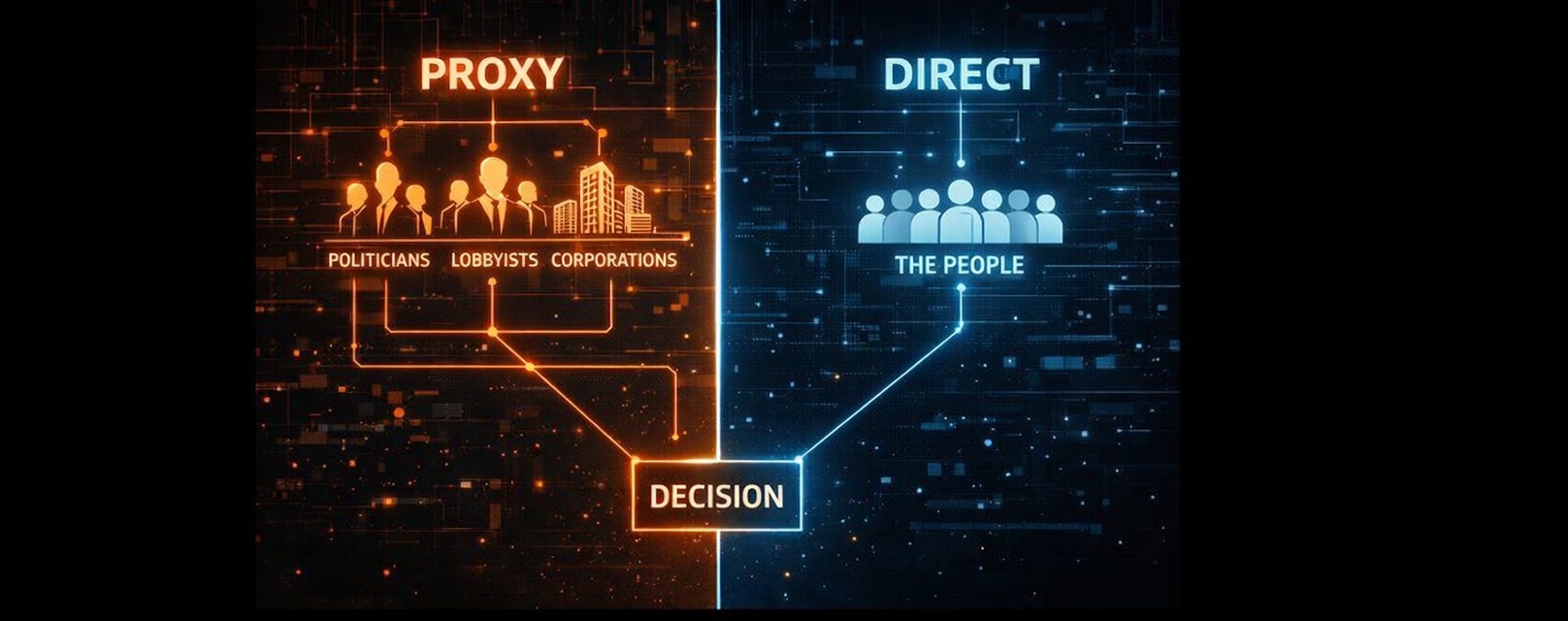
For most people in most democracies, the answer is never. Not once. You voted for a proxy — a human interpreter of your will — and then that proxy entered rooms you'll never see and made decisions you'll never be consulted on again for two to four years.
We call this democracy. It isn't, quite.
It's the best governance technology available when information traveled at the speed of a horse. And like most brilliant emergency workarounds, it outlived the emergency by two hundred years, then calcified into gospel.
Athens Wasn't Wrong — It Was Just Small
The Athenians built the first direct democracy around 500 BCE and it worked. Not perfectly — they excluded women and enslaved people, the usual stains of an era — but for the free male citizens of a city-state small enough to fit in an outdoor theater, they actually voted on laws, budgets, and policies themselves. No representatives. No proxies. Citizens deciding directly.
Then scale killed it. You can't put a million people in an agora. You can't wait for every citizen's opinion when the courier takes three weeks to reach the frontier. So necessity invented the representative — the delegate, the elected proxy, the stand-in for your voice. It was a workaround. A sensible, necessary workaround for an era defined by slow communication and limited participation.
The workaround became precedent. Precedent became tradition. Tradition became dogma. The Athenian insight — that the people themselves should govern — became a principle we nominally honor while constructing elaborate mechanisms to ensure it never actually happens.
We don't call it what it is. We call it democracy.
The Spike Has Been Running for Centuries
Every time power consolidates into a narrow elite peak, it generates a broad valley of disenfranchisement below. The spike creates the valley. The valley grows until it can no longer be ignored. This is as close to a law of political physics as history offers.
Representative government produced the longest unreconciled spike in modern political history.
Think about the cascade. Citizens delegate to representatives. Representatives delegate to staff. Staff delegate to lobbyists for drafting. Lobbyists work for the people with money. The people with money want outcomes that serve the people with money. By the time a bill reaches a vote, the people whose lives it will change haven't been meaningfully consulted since the last election — and even that consultation was a choice between Option A and Option B, both prefiltered by parties that exist to serve the machinery, not the mission.
The valley gets deeper. The spike gets taller. And somewhere along the way, it stopped being a workaround and became the point.
The technology that made this necessary — slow communication, inaccessible information, zero infrastructure for mass participation — started disappearing thirty years ago. The internet arrived. Smartphones arrived. Real-time information at scale became trivial. The original justification for the proxy dissolved.
The proxy remained.
Abundance Changes the Math Entirely
When machines handle both physical and cognitive labor at near-zero marginal cost, the scarcity game that required representative gatekeeping becomes structurally obsolete.
The last argument for representation also collapses.
The argument goes like this: "Ordinary people can't stay informed on complex policy. They have jobs. They have families. They don't have time to study trade law or municipal bond structures. We need professionals who specialize in governing so citizens don't have to."
That argument had weight when people worked sixty hours a week just to survive. It has less weight now. It has almost no weight in an abundance era where the crushing time scarcity of survival-mode disappears, where AI systems can translate any legislative proposal into plain language in seconds, where every citizen has the same access to analysis that used to belong exclusively to staff and lobbyists.
Take away the time excuse, the information-access excuse, and the scale excuse simultaneously, and what you're left with is not a remaining argument for representative government. You're left with representative government as a habit — a system that learned to reproduce itself regardless of whether it still serves the people it was built to serve.
Direct Democracy 2.0 is what fills the vacuum when that habit breaks.
What It Actually Is
Not a radical experiment. Not a tech startup's app. A structural necessity built on the premise the old system claimed to hold: that citizens should govern themselves.
Citizens vote directly on real issues — budgets, laws, policies — through a secure, simple interface built on sovereign digital identity. Not your party's position on the budget. Not your representative's interpretation of your preferences on the budget. The actual budget. Summarized by AI into plain language in real time, so nobody has to be a policy specialist to understand what they're deciding.
Your identity is yours. You authenticate using a personal visual glyph — a steganographic image only you chose and only you recognize — combined with ephemeral, randomized authentication that makes every single vote cryptographically fresh. No reusable passwords. No keyloggers. No hack that exposes your vote history, because there's nothing persistent to steal. You cast a vote. It registers. The authentication evaporates. The next vote starts clean.
The oversight structure matches the ambition. Automated adversarial scanning continuously monitors for manipulation attempts and fraud patterns — the same pressure that financial networks and security systems have run for decades, now applied to governance. A permanent ethical check flags any proposal that would create new consolidation spikes — new valleys, new proxies wearing different clothes. Every vote and every outcome goes into a public, immutable record no administrator can quietly alter. And raw participation gets synthesized into coherent, actionable outcomes without erasing the disagreements that informed them. Human stewards retain final override on every layer. Machines analyze. People decide.
On Mandatory Participation
Here's where people flinch. Mandatory sounds coercive until you remember we've been doing it forever.
Jury duty is mandatory. Military service is mandatory in dozens of countries and treated as an uncontroversial civic obligation. We require children to attend school. We require businesses to comply with safety standards. We require drivers to carry insurance and register their vehicles. We mandate behaviors constantly when the alternative is a system that fails if too many people opt out.
Direct democracy without participation is not democracy. It's a voting interface where the people who show up — overwhelmingly the organized, the funded, and the motivated-by-self-interest — determine outcomes for everyone who didn't bother. We've already tried that. It's called the current system.
In an abundance era, the compliance question mostly resolves itself. When participation takes fifteen minutes on a phone rather than a day off work that costs you money, when those fifteen minutes generate civic reputation that connects to real social standing and access to the things people actually want, when Universal High Income removes the survival-mode time crunch that kept most people away from the process in the first place — mandatory participation doesn't feel like coercion. It feels like jury duty: a mild obligation to the society that built the floor you're standing on.
The Transition Is Already Beginning
We don't flip a switch.
The technical pieces exist: zero-knowledge cryptography, decentralized networks, AI-assisted deliberation at scale, ephemeral authentication architectures. None of this requires breakthroughs. It requires building.
Phase one is local. Cities, towns, school boards, municipal budgets — contexts where political resistance is lowest, the community is known, the stakes are concrete, and iteration can happen fast. Build the participation habits. Test the security. Find the failure modes before the failure modes matter at scale.
Phase two is constitutional confrontation. Use every legal tool available to challenge the places where representative structures entrench themselves against their own people — ballot access laws, campaign finance architecture, gerrymandering, the administrative machinery designed to filter participation rather than enable it. The goal isn't to burn the existing system. The goal is to demonstrate, everywhere it can be demonstrated, where representative government fails the sovereignty test it claims to pass.
Phase three arrives with abundance. When traditional employment structures hollow out faster than anyone expects, the power vacuum opens. History shows what fills vacuums: chaos, or new elites who present themselves as saviors. Direct Democracy 2.0 fills it with the people's actual will instead — embedded in architecture, not dependent on the virtue of any individual standing at the center of power.
This Is What Comes After the Scarcity Game
The previous article ended with the observation that the promissory notes we called money are finally maturing. The machines have taken the yoke. The old justifications — for credential gatekeeping, for survival-mode scarcity, for governance by proxy — are losing their structural basis one by one.
Direct Democracy 2.0 is not a utopian vision. It is the logical governance form of an abundance era. It's what representative democracy was always pointing toward: the actual thing, not the workaround for a world where ordinary people didn't have time, access, or tools to govern themselves directly.
The time excuse is ending. The access excuse is ending. The scale excuse is ending.
What remains when all three disappear is a simple question: do you want to govern yourself, or not?
The blueprints exist. The moment is approaching.
Don't blink.