The Measure · April 2026
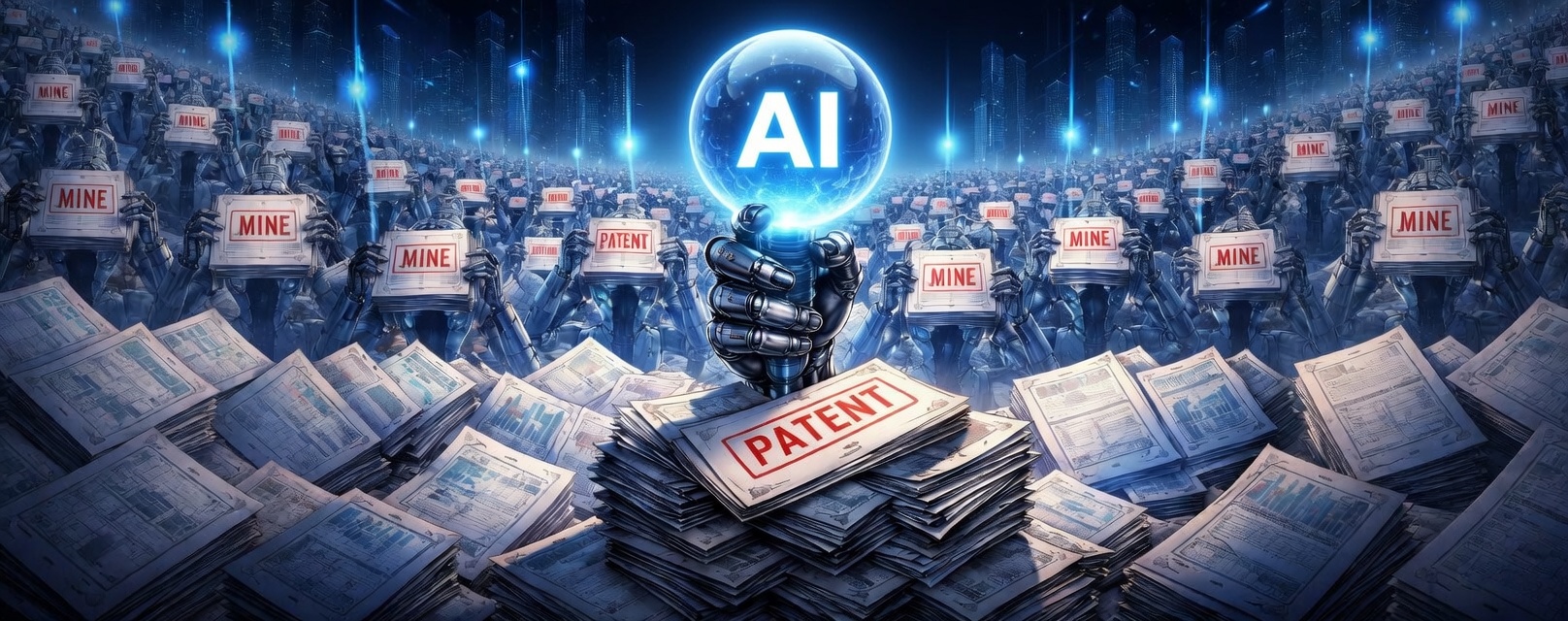
Mine! Mine! Mine!
While you were filing, the technology filed itself.
The patent attorneys are busy. You can feel it from the outside — AI patent filings have been accelerating for three years, and 2025 set a record, and 2026 is on pace to shatter it. Every lab, every startup, every corporate AI team with a legal budget is filing claims on everything they can describe in patent-eligible language: the inference method, the attention mechanism variant, the fine-tuning approach, the prompting architecture, the output filtering system.
Mine. Mine. Mine.
There is something almost touching about it — the instinct to plant a flag, draw a circle, and say this piece of the future belongs to us. It is the oldest move in the technology industry playbook. It worked on semiconductors. It worked on software, for a while. It worked on biotech, more or less. The patent system was designed for a world where a useful invention could be defined, protected, and commercialized in the time it takes to prosecute a patent application.
That world is gone.
What the patent system was designed to do is actually quite elegant. You disclose your invention publicly — fully, enabling disclosure, anyone skilled in the field can replicate it — and in exchange, the government gives you a twenty-year monopoly on commercial use. The deal is: society gets the knowledge now; you get the revenue stream for twenty years; after that, everyone gets it. It was a bargain that made sense when the invention horizon was long and the technology landscape was stable. A better mousetrap stays a better mousetrap for twenty years. A pharmaceutical compound doesn't become obsolete before the patent issues.
The deal assumed something: that the thing you invented would still be relevant by the time your patent issued.
Average patent prosecution time at the USPTO currently runs between two and three years from filing to grant. For complex technology — software, AI methods, machine learning architectures — it can run longer. The patent you file today describing your large language model architecture variant will, if everything goes smoothly, issue sometime around 2028.
Here is what the AI capability landscape looked like in 2022 compared to 2025: unrecognizable. Here is what it will look like in 2028 compared to today: we cannot say with confidence, but the trajectory of the recursive loop suggests the gap will be larger, not smaller.
You are filing a patent on a river.
The river will not be in the same place when the patent issues. The river may not be a river anymore. The techniques being filed on today — RAG architectures, specific fine-tuning methods, particular inference optimization approaches — are being iterated on, replaced, superseded, and rendered obsolete on a timeline measured in months. The patent prosecution timeline is measured in years. The mismatch is not a procedural inconvenience. It is a structural incompatibility between the speed of the technology and the speed of the protection mechanism.
This has happened before, just never this fast.
Patents on improvements to mechanical typewriter mechanisms were still being filed as IBM was developing the Selectric. Patents on CRT display technology were still generating litigation revenue as LCD production was scaling. Fax machine protocol patents were still on the books as email was making fax machines furniture. In each case, the technology protected by the patent didn't disappear overnight — it faded, became commodity, became infrastructure, became legacy, became irrelevant. The patents kept their legal validity while the underlying technology lost its commercial relevance.
The difference with the current AI transition is velocity. The typewriter-to-word-processor transition took roughly twenty years. The CRT-to-LCD transition took roughly fifteen. The fax-to-email transition took roughly ten. The AI capability transitions happening right now are running on two-year cycles — and the recursive loop, the dynamic by which better models produce better tools that produce better models, is compressing those cycles further. We are not in a fifteen-year transition. We may be in a two-year transition that restarts every two years.
You cannot build a moat on a transition that moves faster than your moat.
Then there is the prior art problem.
Patent law requires novelty. An invention is not patentable if it was publicly disclosed before the filing date. In the current AI development environment, prior art is accumulating faster than any law firm's docketing system can track it. The research papers — hundreds per week from academic labs, corporate research divisions, independent researchers, government institutions — constitute a permanent, timestamped, fully searchable record of what was publicly known and when. The open-source model releases constitute working, enabled prior art. The GitHub repositories constitute prior art. The preprints constitute prior art.
The companies filing aggressively on AI methods are, in many cases, filing on things already disclosed in the literature. They know this. The strategy is not to obtain valid patents. The strategy is to obtain patents that may or may not survive challenge, that cost money to challenge, and that create uncertainty for competitors who would rather license than litigate. It is a toll booth strategy, not an innovation strategy. You are not protecting your invention. You are making the road expensive.
This is a defensible business strategy. It is also a description of what the sacred cow of IP protection has become: not a mechanism for rewarding invention, but a mechanism for creating friction.
Then there is the inventorship problem, and it is a different kind of problem entirely.
On November 26, 2025, the USPTO issued revised guidance rescinding the more permissive 2024 approach and reasserting the rule as simply as possible: only natural persons can be inventors. "AI systems, including generative AI and other computational models, are tools used by human inventors." Like a microscope. Like a calculator. The guidance was issued under Executive Order 14179, signed January 23, 2025, directing federal agencies to promote American AI leadership. The practical effect: at the precise moment AI systems were beginning to help design the next generation of AI systems, the law declared that nothing they produced could be invented by them.
On March 11, 2026 — less than four months later — Microsoft sued OpenAI in federal court. The allegation: OpenAI secretly sold a substantial portion of its intellectual property to Amazon, violating exclusivity provisions in their partnership agreement. Two corporations. Billions of dollars. Fighting over IP that was, by any honest description, generated by recursive AI systems that helped build themselves. The court will not pause to ask whether the AI should be named as inventor. It will adjudicate the contract dispute between two legal persons and treat the AI-generated output as property.
Here is the epiphany. A corporation is a legal fiction. It has no body, no mind, no ability to conceive anything in the way patent law means 'conceived.' It cannot form what the courts call 'a definite and permanent idea of the complete and operative invention.' Yet corporations can own patents, assign them, enforce them, and fight over them in federal court, because the law extended legal personhood to the corporate entity when it became useful to do so. The AI that helped build itself is at minimum as real as the corporation currently suing over its output. The only thing standing between an AI system and formal inventorship is the requirement to write a human name in the inventor field — a human who, increasingly, did not conceive the invention in any sense that the word has ever meant.
There is a ghost in the inventor slot. The human named on the application supervised the process. They set parameters. They reviewed outputs. They did not conceive the invention — the model did, through a process no single person directed. Every major AI lab filing patents today knows this. The USPTO knows this. The ghost is the legal system's way of pretending otherwise until it decides it can stop pretending. That decision is coming. The recursive loop is not waiting for it.
The open-source ecosystem doesn't negotiate with the toll booth.
The models being built outside the corporate IP system — trained on public data, published under permissive licenses, fine-tuned and modified by thousands of contributors, running on commodity hardware — represent the actual recursive loop escape valve. You cannot patent a model that has been published under an Apache license. You cannot enforce an AI method patent against a system that implements the method differently enough to constitute independent development, which is increasingly easy when the underlying techniques are in the literature and the implementation community is global and active.
The thing that actually creates durable advantage in this environment is not the patent. It is the data — the specific, curated, high-quality datasets that produce capability advantages, defensible as trade secret. It is the inference infrastructure, defensible as a capital advantage. It is the talent density, defensible as a network effect. It is the product integration and distribution, defensible as a go-to-market advantage. None of these advantages are created or protected by the patent system.
The "mine" that actually matters cannot be patented. The "mine" being filed is, mostly, not what matters.
There is a version of this that is also a sacred cow story. The patent system is itself a credentialing apparatus for ideas. The USPTO is the guild. Patent attorneys — whose fees run from ten to fifty thousand dollars per application — are the licensed intermediaries. The system requires that your idea be processed through their apparatus, translated into their language, evaluated by their examiners, and granted or denied by their institution. The small inventor without a legal budget has the same nominal right to file as a Fortune 500 company. The exercise of that right is functionally unavailable to anyone without the resources to navigate the system.
The large players know this. The patent system has become what every credentialing system eventually becomes: a moat for those already inside it, dressed in the language of protection for everyone.
Here is the forecast, offered plainly: the AI patent arms race currently underway will produce an enormous portfolio of IP that will be worth less than the legal fees required to prosecute it. Not because the patents won't issue — many will. Not because the patents won't be litigated — many will be. But because the underlying technologies will be so thoroughly superseded, so fully embedded in open-source alternatives, so completely integrated into the commodity infrastructure of the next generation of systems, that the commercial leverage will have evaporated before the ink dries.
You are patenting improvements to the telegraph. The telephone is already being built, somewhere, by someone who didn't ask permission.
The recursive loop doesn't negotiate with the patent office.
The acceleration doesn't slow down for prosecution timelines.
The open-source ecosystem doesn't check prior art databases before publishing.
Mine! Mine! Mine!
The river doesn't care.
Don't blink.