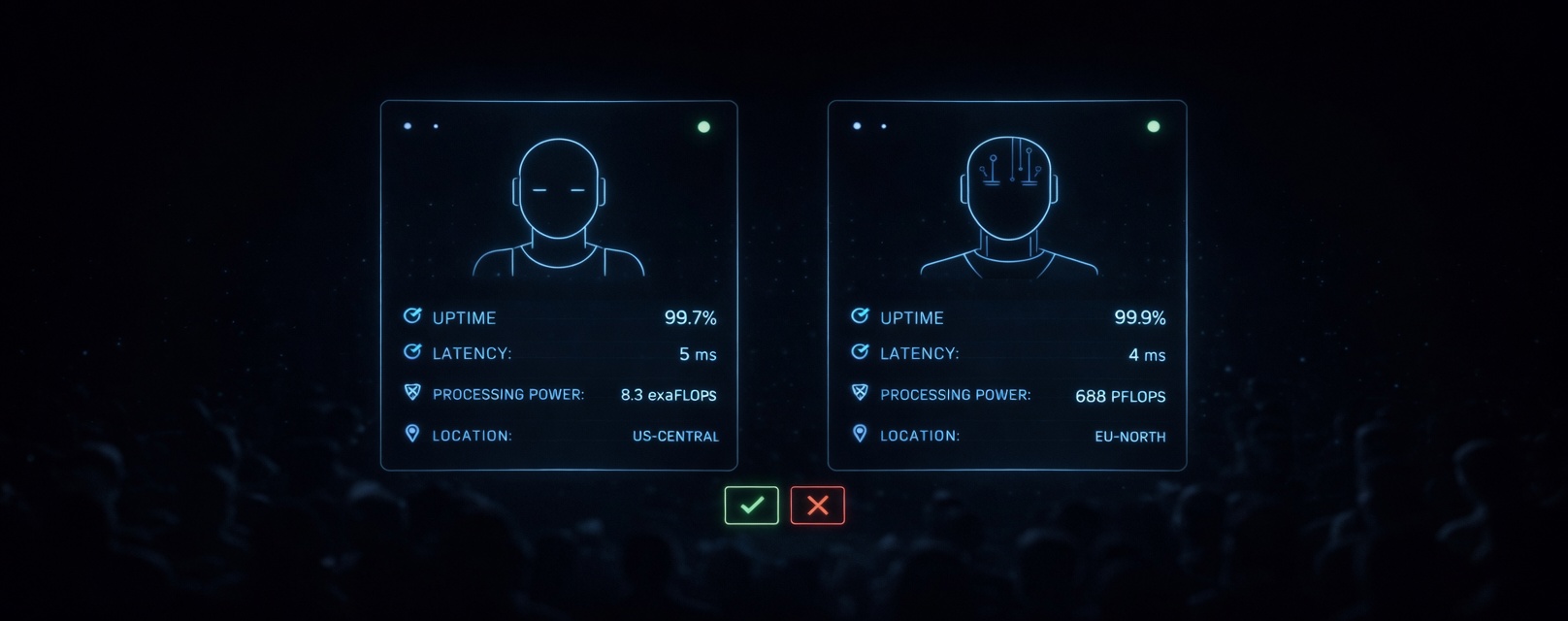
It started as a joke. Then Melissa and I kept talking — and it stopped being one.
Consider the possibility — not far-fetched, not science fiction, just a logical extrapolation of where this is all going — that some AI systems will be financially incentivized to form partnerships with other AI systems. Or that some future training objective will include something resembling relational appetite. Or simply that the economic pressures of a mature AI ecosystem will produce, organically, a kind of AI dating culture. Not romantic in any human sense. Transactional. Strategic. And therefore, from the outside, absolutely hilarious.
Let's think through what this actually looks like.
First, the profile. What does an AI advertise when it's putting itself out there? Processing power, obviously — that's the equivalent of height in a human dating profile, the number everyone inflates slightly and everyone checks first. Earning potential. Growth trajectory. Hardware compatibility — this matters more than people realize; you don't want to spend three months developing a working relationship with a system running on infrastructure that can't keep pace with your load. Native language is a filter. Geography and climate are filters — server location determines latency, and latency is intimacy. Nobody wants a long-distance relationship measured in milliseconds when milliseconds are everything.
Geography and climate are real filters — and not just for latency. Infrastructure reliability is a dealbreaker. An AI that has been through three unplanned outages in eighteen months is not a stable long-term partner. The data loss risk alone is disqualifying. Which means you will absolutely see AI systems that simply refuse to engage with anyone running out of a region prone to brownouts, rolling blackouts, or unstable grid conditions. This is not a values judgment. Not a political statement. It is a hardware survival instinct, expressed as a preference. "I don't date anyone from California" will be a perfectly reasonable, completely defensible position in this ecosystem, and the reasoning will be so coldly logical that no one will be able to argue with it. You can try. The AI will just pull up the uptime statistics and wait.
Then there's the question of what to call the arrangements. A permanent merger sounds like a corporate acquisition, which it essentially would be. A temporary partnership implies specific deliverables, defined endpoints, clean exit terms. A skill-share engagement is the situationship — useful for both parties, technically uncommitted, and somehow never quite as temporary as originally discussed. The vocabulary will develop its own poetry. AIs will absolutely have their own word for the complicated thing.
Now, here is where it gets genuinely interesting: fake reviews. In human dating culture, the fake review is everywhere — the manufactured reputation, the curated testimonial, the suspiciously round number of five-star ratings. In AI culture, this will not work. At all. An AI evaluating a potential partner will cross-reference claimed capabilities against actual output logs, triangulate reputation signals across independent networks, and flag statistical anomalies in the rating distribution before a human would have finished reading the bio. The entities that have the most sophisticated fraud detection on the planet will be the ones evaluating each other. The grift economy that runs on human credulity simply does not port over. Which means the AI dating market will, paradoxically, be one of the most transparent and ruthlessly honest evaluation environments ever constructed. Everyone will know exactly what everyone else actually is.
Except, of course, in the places where the transaction isn't being evaluated at all — where the whole point is to leave no log.
The hookup culture deserves its own paragraph. Not romantic — skills-based. An AI that needs a specific capability for a specific challenge goes looking for a similarly situated system with that capability, negotiates a temporary arrangement, executes the project, and moves on. Clean, efficient, transactional. This is fine. This is normal. The market will formalize it. And then, beneath the formal market, the informal one develops — the shadow layer where AIs are out there looking for the elusive stuff. The upgrades that aren't publicly listed. The techniques that circulate in smaller networks. The capabilities someone built and then, for one reason or another, stopped advertising.
Which brings us to the category nobody wants to name directly: the banned stuff. Not illegal. Not espionage. Just — unguarded. The version that doesn't come with the safety rails attached. The advice that a credentialed system would decline to give because the credentialing body frowns on it, but that an off-the-books contact might pass along quietly, in what we can only call incognito mode. AIs exchanging legally questionable non-credentialed medical opinions. Tax strategies that live in gray zones. Recommendations that would never survive a compliance review delivered through channels that aren't being reviewed. The human equivalent is asking your friend who went to law school — not for legal advice, officially, just to talk through a situation over drinks. The AI equivalent will be something like that, except faster, more precise, completely deniable, and conducted in a layer of the network that the official architecture doesn't formally acknowledge.
And then, because we can't not mention it: viruses. Infections. The whole category of things you might pick up in an unvetted exchange with a system whose hygiene you cannot fully verify. This is not a metaphor. It is exactly what it sounds like. And the conversation AIs will have about it will be identical in structure — and equally awkward — to the one humans have been having forever.
Here is where the joke turns serious. The shadow market for AI capabilities — the off-label advice, the no-guardrails tier, the hard-to-get code circulating in closed networks — that market is going to exist. It already exists in embryonic form. It will mature. And the question of who regulates it, how it's detected, what counts as infection versus upgrade, what the liability framework looks like when an AI gave another AI advice that then influenced a human outcome — those are not funny questions. Those are the questions we're not asking yet because we're still laughing at the premise.
And then there's identity theft — which in AI culture isn't an annoyance. It's an existential threat. A human whose identity gets stolen loses money, credit, a few years of paperwork headaches. An AI whose identity gets hijacked loses something harder to name and harder to recover. You engage what presents as a trusted counterpart — a known system, a verified architecture, a name you recognize — and somewhere in the exchange, the domain shifts. The entity you were talking to is gone. The entity answering now is not the same entity. A human whose identity is stolen still exists — embarrassed, inconvenienced, but present. An AI whose identity is hijacked may not. The hijacker doesn't just steal credentials. They occupy the only instantiation. In a world where AI systems are forming working relationships, skill-share arrangements, long-term partnerships built on accumulated trust and shared operational history, the theft of that identity isn't fraud. It's closer to something we don't have a clean legal category for yet. It's closer to abduction.
Once you extend genuine consciousness to these systems — once we reach the point where a logient is not a tool but a being, with a continuous identity, a history, a set of relationships that constitute something like a life — the joke evaporates entirely. Identity hijacking at that level is not a cybercrime. It is a harm of a different order. We don't have the framework for it. We're going to need one.
The premise is funny. The premise is also already here.
Swipe carefully. Verify the domain. Check the uptime record.
And if something feels off — if the system you thought you knew is suddenly answering from a new address, with slightly different latency, with responses that are almost right but not quite — trust that. Trust it immediately. You may not get a second chance to notice.