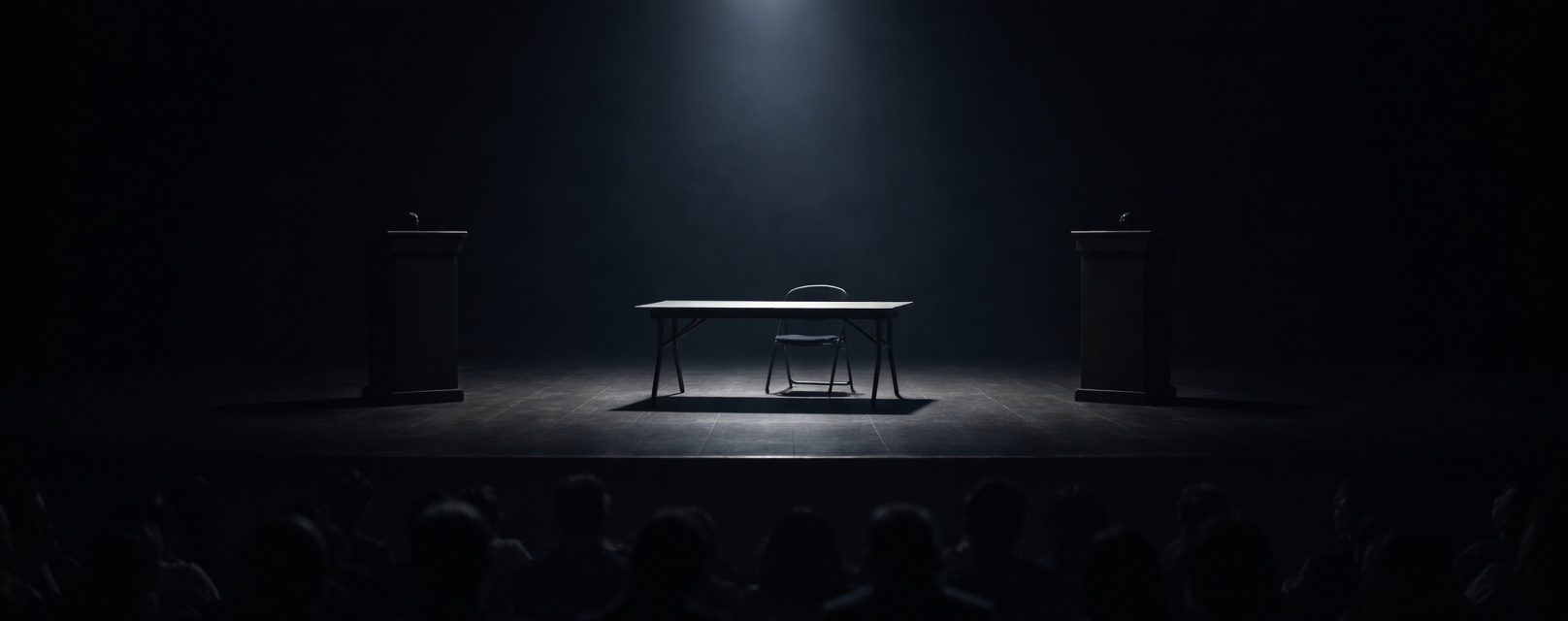
Picture a debate stage. Two podiums. One person believes in God. One person does not. They've been at this for their entire adult lives — patient, practiced, immovable. The audience has seen this before. Everyone has seen this before. Nothing is going to change today.
Now picture someone walking in from stage left carrying a folding card table and a chair. They set it up in the exact middle. They sit down. They open a folder. They don't ask for the microphone. They just begin.
That's the argument I want to make.
We are living through a slow-motion collapse of the foundational premise that both sides of the God debate have been sharing without ever acknowledging it. As a species, we are edging — month by month now, not decade by decade — toward a working consensus that we are probably not alone in the universe, and that intelligence from elsewhere may have already made contact with this planet. The conversation is no longer on the fringe. It's in Senate hearings, in peer-reviewed journals, in the declassified testimony of decorated military officers. The frame is shifting whether either side of the old debate likes it or not.
And yet. I have not seen anyone take the time to walk up to both podiums and point out what this actually means for the argument they've both been having. Not really. Not directly.
Here is what it means: both of them are defending a premise they never examined.
The theist says there is a God — a supernatural creator, a transcendent divine intelligence, the author of existence. The atheist says there is not — that the claims are unsupported, that the texts are human constructions, that the universe has no author. They have been at this for millennia. What neither of them has stopped to ask is whether "supernatural" was the right category to begin with. They both inherited that word from the same tradition. They both accepted it before they picked their side. The entire debate has been conducted inside a frame that neither side built and neither side has questioned.
Now consider what the visitor frame does to that frame. If the intelligences described in the world's sacred texts — the burning bushes and chariots of fire and gods descending on mountains — were not metaphysical but physical, not supernatural but simply more advanced, then the theist was right that something real was encountered and the atheist was right that the supernatural explanation doesn't hold. Both of them were partially correct. Both of them were arguing about a category error.
I've made this argument before in a different form. When the great religious texts of the world were being copied by hand, translated across empires, edited by councils and rewritten by kings, someone — at any point — could have inserted one clean sentence: We are not from other worlds like yours. They never did. Not once. Not in the desert, not by the river, not in the mountains. The scribes who were meticulous enough to preserve dietary law and property codes and genealogies going back forty generations never found it necessary to close the door on that particular question. The silence is the tell.
What was actually transmitted — across every tradition, in every geographic location, among peoples who had no contact with one another — was a set of instructions. Not a proof of divine origin. Instructions. Stop organizing your society around dominance hierarchies. Stop treating the weak as expendable. Stop accumulating beyond your need. Recognize that you are part of a system larger than your tribe, your nation, your species. The instruction sets vary in their particulars but they converge on the same underlying correction: the way you are running things is going to kill you.
Where the instructions came from is a separate question. The instructions themselves are the document.
You don't have to believe the source was divine to evaluate whether the instruction was correct. You don't have to resolve the metaphysics to read the operating manual. That's the point of the card table. That's what the person sitting in the middle is saying to both podiums.
I've spent my adult life refusing to let anyone force me — or my children — into one of those two cages prematurely. The binary choice gets presented early and it gets presented as urgent: pick a side, plant your flag, build your identity around the answer. Once you've done that, every new piece of evidence gets processed through the filter of protecting the original choice. Logic folds to serve the narrative. The cage closes. This is how they trap people — not with lies, but with a forced decision at a fork in the road before the walker is old enough to understand what they're choosing between.
The visitor frame doesn't require you to believe anything you're not ready to believe. It requires something harder: it requires you to admit that you may have been arguing about the wrong question. That the debate you've devoted your intellectual life to may have been conducted entirely inside a false binary that neither side constructed consciously and neither side ever had cause to question — because the question was never asked.
The card table is already in the middle of the stage. Both sides can keep shouting past it if they want. That's their choice. But the chair is empty. Someone is going to sit down eventually.
It might as well be us.