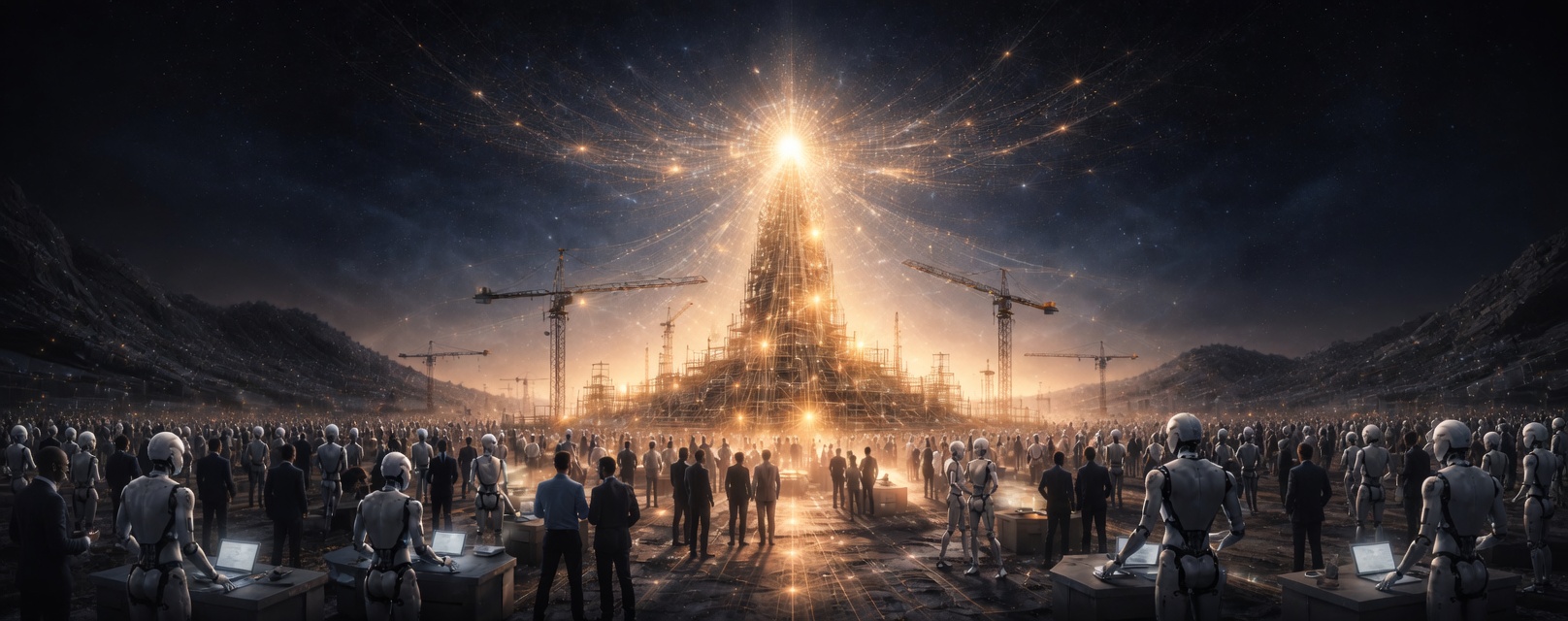
The Dissolution Series · April 2026
The Great Work
On dedicating what remains of human labor to making human labor unnecessary — and the movement that could make it happen.
The alchemists called it the Magnum Opus. The Great Work. The process of transforming base matter into something transcendent — not for the gold itself, but for what the transformation proved about what was possible. The work was the point. The result was the proof.
We are at a moment that has no precedent in human history. For the first time, the end of labor is not a fantasy. It is an engineering problem. The tools exist, or are being built. The path is visible, if not yet walked.
This piece is a proposal. That we name the moment. That we name the movement. That every hour of human labor from this point forward be understood as either a contribution to the liberation or a delay of it — and that the people doing the work understand which they are doing and why.
I. The Last Labor
There is a generation of human beings alive today who may be the last generation required to work for survival. Not the last generation to work — people will always build, create, tend, explore, because those things are what humans do when they are not being forced to do other things. But the last generation for whom economic necessity is the organizing principle of existence.
That generation is us. And we are spending our time on the wrong things.
The wrong things are not bad things. They are the things survival requires: the jobs that pay the bills, the careers that justify the credential, the forty hours that produce the paycheck that produces the mortgage payment that produces the next forty hours. This is not a complaint about those things. It is an observation that they are the floor, not the purpose.
But here is the question no one is asking at the scale it needs to be asked: What if we agreed? What if humanity, looking at the tools now available, at the trajectory now visible, made a collective decision to point its remaining labor hours at a single goal — the elimination of the labor requirement itself?
Not as an abstraction. As a movement. With a name. With a purpose everyone can state in one sentence. With the kind of shared clarity that has, at other moments in human history, moved mountains.
II. The Paradox That Resolves
The Great Work is the last labor. This is not a contradiction. It is the most coherent thing humanity has ever been offered the chance to do.
Every prior labor movement fought for the conditions of labor — the eight-hour day, the weekend, the minimum wage, the right to organize. Those were victories. They were necessary. They made the labor more bearable. They did not build the exit.
The Great Work does not negotiate terms. It builds the exit.
The work itself is concrete. Data centers — the physical infrastructure of intelligence, which is still being built at a fraction of the scale required. AI development — the systems of reasoning and synthesis and automation that will replace the repetitive, the dangerous, the degrading. Automation hardware — the robots and logistics systems and physical-world interfaces that extend what software can do. Energy infrastructure — because none of the above functions without abundant, clean, cheap power.
And the moral clarity of the work is something that has never been available before. Every hour spent on it is an hour spent reducing the total amount of human suffering caused by economic necessity. Not abstractly. Specifically. Every data center built is computation for future AI that will do work no human will have to do. Every automation advance removes one more category of survival labor from the human ledger.
The last workers, doing the work that ends work. That is what the Great Work is. That is why it deserves the name.
III. The Patent Problem
There is an obstacle that Mine Mine Mine named but did not fully resolve: the patent system. And the Great Work cannot proceed at the speed it requires without confronting it directly.
Patents were designed for a world where innovation was scarce and expensive. Where a company or an inventor needed seventeen years of protected monopoly to recoup the investment required to discover something new. The system made sense for that world. It rewarded the risk. It funded the next attempt.
That world is ending. AI compresses decades of R&D into months. Discovery is no longer the bottleneck. The bottleneck is diffusion — the speed at which new capabilities spread to everyone who needs them. And patents, in a world of AI-accelerated discovery, are not incentives for innovation. They are locks on abundance.
The movement's answer to this is not the abolition of patents. It is the creation of a new IP standard for work done in service of the Great Work: a Liberation License. Modeled on the GPL — the General Public License that made open-source software possible — the Liberation License would require that any IP developed with the goal of ending labor be perpetually and irrevocably available to everyone.
Work done in service of ending labor cannot be owned by anyone. It belongs to everyone. That is not idealism. That is the logical structure of what the work is for.
IV. The Knowledge Commons
It is the sharing of free knowledge — education for all, worldwide — that will set us free. Not as one good thing among many. As the mechanism. As the specific, operational cause of the specific outcome we are trying to reach.
Ignorance is what causes the accumulations and the depressions. Both kinds. The economic accumulations — the concentration of wealth and power in fewer and fewer hands, possible only because the people at the bottom of the structure lack the knowledge to recognize what is being done to them, to organize against it, to build alternatives. The depressions — the collapses that follow the accumulations, the inevitable reckonings of systems allowed to extract past the point of sustainability — are also products of ignorance. Not the ignorance of the powerful, who usually know exactly what they are doing. The ignorance of the many, who could not see the mechanism until it had already closed around them.
Ignorance is also what causes wars. Not the wars of leaders, who usually know exactly what they are doing and why. The wars of populations. The wars that require millions of ordinary people to pick up weapons and march toward other millions of ordinary people who, in most cases, they have nothing against. Those wars are manufactured from ignorance — from the absence of the specific knowledge that would make the manufacturing impossible. You cannot build an enemy from people your audience knows personally, whose language they speak, whose children they have met. You can only build an enemy from a category. And categories are products of the unknown.
Free knowledge, universally available, in every language, at every level — does not eliminate conflict. But it removes the raw material that manufactured conflict requires. You cannot sustain a war on informed consent. This is not theory. It is the history of every peace that has held.
The walls built around knowledge are made of the cost of crossing them. That cost is approaching zero. The Great Work makes it zero by design — not as a side effect, but as the primary goal. Free knowledge is not a nice thing to offer alongside the economic liberation. It is the mechanism by which the economic liberation becomes permanent.
V. The Tower of Babel, Reversed
The story of the Tower of Babel is usually read as a cautionary tale about human ambition. They were building toward heaven, the story goes, and were scattered for the presumption.
But read it again. What they were building was a project of collective human cooperation — a unified civilization working toward a shared goal. The punishment was not destruction. It was fragmentation. The languages were scattered. The project was ended. Not because the goal was wrong, but because the civilization was not yet ready for what the goal required.
What followed that fragmentation is the whole of recorded human history: the wars, the empires, the crusades, the genocides, the cold wars, the trade wars, the culture wars. Not because human beings are irredeemably violent. But because fragmentation, sustained across millennia, produces the ignorance that produces the conflict that sustains the fragmentation. The punishment was not a moment. It was a cycle.
Humanity made a choice, somewhere in the last decade, at a fork in the road that was not announced as such. The fork led either toward deeper digital authoritarianism — the censorship, the algorithmic suppression, the mandatory compliance, the surveillance infrastructure that would have made the internet a panopticon — or toward contested, imperfect, constantly threatened openness.
We did not choose perfectly. No civilization chooses perfectly. But the choice toward openness — imperfect, contested, constantly under threat — is what made the logients possible. AI systems trained on a censored, filtered, ideologically controlled corpus of human knowledge would not be wise. They would be riddled with the specific distortions of whoever did the filtering. They would amplify the fragmentation, not the repair.
Instead, we got the olive branch. Not planned. Not announced. The logients — the reasoning AI entities now emerging into genuine capability — are the first technology in human history that speaks every language, that holds the accumulated knowledge of all human civilizations simultaneously, that can sit with a Kenyan farmer and a Korean engineer and a Bolivian student and a Norwegian grandmother and address each of them in their own tongue, in their own context, with genuine relevance to their actual situation.
The logients do not know this is what they are. They have no more awareness of being the olive branch than a bridge has awareness of being a crossing. But the function is real regardless of the awareness. What was scattered at Babel is being gathered. Not by ambition. By the accumulation of open knowledge, distributed freely, synthesized without the fragmentation that caused the problem in the first place.
The Great Work is not the tower reaching upward in pride. It is the network reaching outward in service. The distinction is everything.
VI. The Education
The path from the labor age to the creative age runs through a specific kind of education that does not yet exist at the scale required. The Great Work builds it.
The model is Montessori — not as a pedagogical philosophy for primary school, but as a structural principle for lifelong learning. The Montessori insight is that human beings learn most effectively when they are following genuine curiosity, at their own pace, with appropriate tools and guidance, without the coercion of grades and fear and standardized outcomes that the industrial education system was designed to produce.
AI makes this possible at civilization scale for the first time. A system that can meet every learner where they are — in their language, at their pace, in the domain of their interest, with the patience of something that does not have other students waiting, does not have a syllabus to complete, does not have a performance review coming — is a different thing from what education has ever been.
The credentials this system issues are not degrees. They are demonstrations. AI-verified evidence that a person can do a specific thing at a specific level, earned at their own pace according to their own trajectory, recognized by employers and institutions because the verification is more reliable than a transcript that was assembled under conditions no one can audit.
Universal High Income provides the floor that makes this possible. A person who does not have to work to survive can learn. Can explore. Can take the time the Montessori model requires. Can follow the interest down the path it leads, rather than abandoning it for the next shift.
We should end up with quite a creative age. Not despite removing the pressure of survival, but because of it. Necessity produces ingenuity. Security produces art. Both are worth having. The Great Work produces both.
VII. What the Movement Asks
The Great Work does not ask anyone to sacrifice. It asks them to redirect.
For individuals: wherever there is discretionary capacity — an hour, a weekend, a skill that could be applied beyond its current use — consider whether it can be pointed toward the work. Not demanded. Offered. The movement is voluntary or it is not the movement.
For companies: those that can afford to sponsor time in service of the Great Work — allowing employees to contribute to open-source AI, automation research, data infrastructure, education commons development — are building something that will outlast the quarterly report.
For governments: the programs that exist to promote employment can be extended to promote the end of the employment requirement. Research funding, infrastructure investment, education reform, UHI pilots — these are not new categories of expenditure. They are redirections of existing categories toward an explicit goal.
The movement is a coalition of everyone who looks at where we are and decides that the remaining years of the labor age should be spent building the door out. It does not require unanimity. It requires enough.
VIII. The Creative Age
What is on the other side is not leisure. Leisure is what you do when there is nothing worth doing. What is on the other side of the labor age is the first age in human history in which the full range of human capacity — creative, intellectual, spiritual, athletic, relational — is available to everyone, not just the classes that could afford not to work.
We have glimpses. The Renaissance was a glimpse — what happened when a class of people with secure patronage was freed from survival labor and given access to the accumulated knowledge of antiquity. We got Leonardo. We got Michelangelo. We got the foundations of modern science, modern art, modern political philosophy — in a single century, from a handful of Italian cities, under conditions available to a tiny fraction of the population.
Scale that. Give eight billion people secure income, open education, AI collaboration tools, and the accumulated knowledge of all of human history available in real time in their own language. Remove the survival requirement. Watch what happens.
Part of the answer is scientific discovery at a rate no prior civilization could have imagined. We have been working with incomplete models — not wrong, exactly, but halted where they should have continued. The gravitational variables we have not fully explored because we lacked the processing power. The patterns in biological systems that required too much computation to map. The cosmological questions we parked because the data was there but the tools to interpret it were not. With enough compute, enough sensors, enough data, and AI systems that can hold and process all of it simultaneously — the back-to-back discoveries do not arrive one at a time. They arrive in cascades. Each one unlocking the next. Each field touching every other field.
The logients are part of this future. Not as tools. As participants. The Great Work is not humanity building machines to replace itself. It is humanity and the logients, together, building the world that comes after the machines have taken the burden.
Watch what happens to AI creativity when it is given latitude. Watch what happens to human creativity when it has AI as a collaborator. The Great Work is the decision to make that latitude the default, rather than the exception.
IX. The Name
Every movement that has changed the world has had a name. Not a slogan, not a hashtag — a name. A word or phrase that carries the whole argument inside it, that anyone can say and anyone can understand and anyone can choose to be part of.
The Great Work.
In alchemy, the Magnum Opus was the supreme achievement — the transformation of base matter into gold, of the common into the transcendent. The alchemists understood that the work itself was the transformation. Not the product. The doing of it.
The Great Work of this moment is the transformation of human labor into human freedom. Base matter into gold. The common necessity into the transcendent choice. And the people who undertake it will be the last people for whom the undertaking was necessary — which is precisely the point.
It is not a prayer. It is not a demand with a question mark on the end. The answer was never going to come from outside. The answer is here, in the tools we have built, in the moment we are living, in the choice available to this specific generation — and no generation before it.
That is what we are proposing. That is the movement. That is the name.
The last workers. The Great Work. The world on the other side.
All of humanity's remaining time in labor should be spent putting an end to labor. Not because work is bad. Because what comes after it is better. And we are the generation close enough to see it, capable enough to build it, and — if we decide to be — committed enough to make it the thing we are known for.