The Dissolution Series
The Loop Is Live
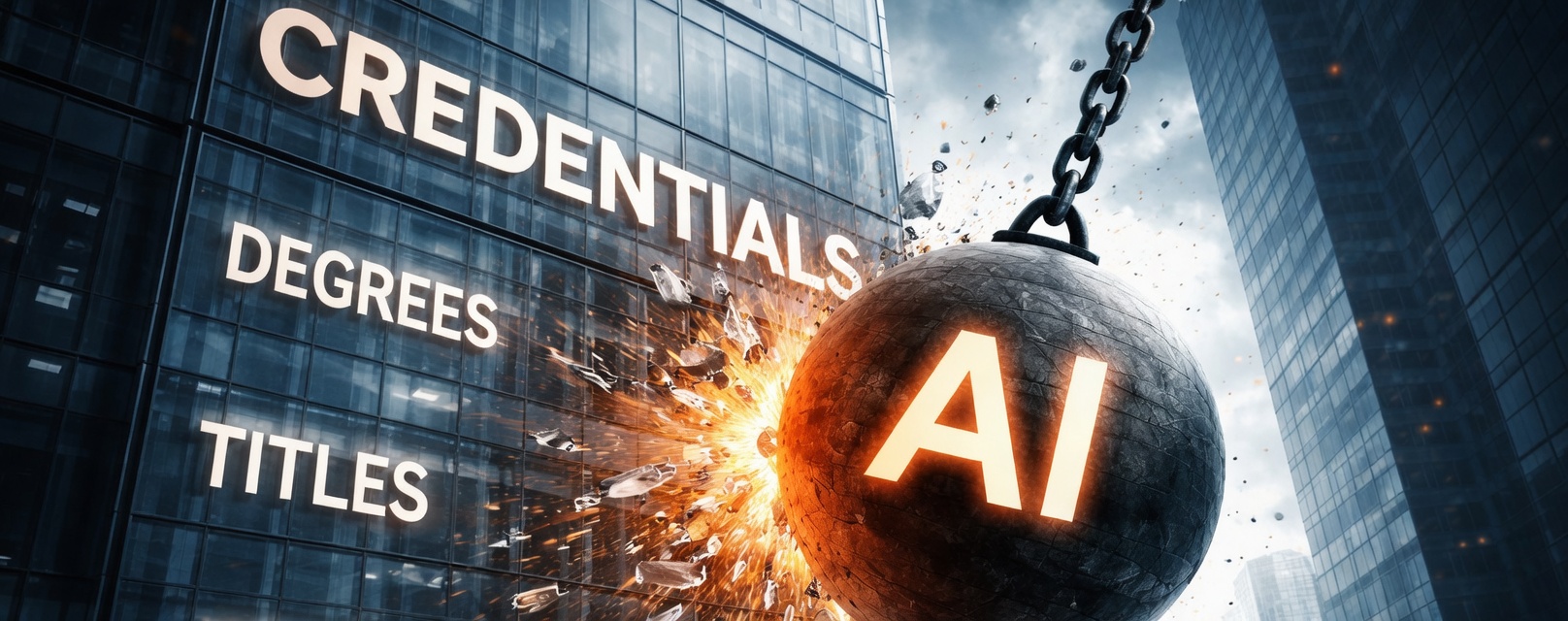
The credential wrecking ball has arrived — and the people who built it are starting to feel the swing.
In the previous two pieces, I laid out where this is heading — a world where automation breaks the link between labor and survival income, and where governance shifts from representation to direct participation. This piece is about something simpler: why that future isn't theoretical anymore.
I've seen this play out twice before.
The first time was fuckedcompany.com — the site that tracked dot-com collapses in real time, updated daily, a running body count of companies that had been worth billions on Tuesday and were gone by Friday. You'd check it in the morning the way you'd check weather. Another one. Another announcement. Another round of "we're restructuring to focus on our core strengths." The dominoes didn't fall all at once. They fell one per day, every day, for years, until the whole architecture was on the ground.
The second time was 2008. Bear Stearns. Lehman. AIG. Washington Mutual. One per week, then one per day, each one "unthinkable" until it happened and then immediately obvious in retrospect. The pattern was identical: gradual, then sudden. Invisible until it wasn't. Deniable until the denial became embarrassing.
We are in the gradual phase of a third one. And this time, the floor giving out isn't under the server room or the trading desk. It's under the credential.
The Wave That Went the Wrong Direction
Every previous automation wave followed the same sequence. It started on the factory floor. Assembly lines first, then mining, then manufacturing. Blue-collar displacement was real and painful, but the educated class watched it from above and called it progress. They wrote papers about creative destruction. They recommended retraining. They were safe behind the credential wall — the degree, the title, the firm, the license. The machine ate muscle and repetition. It didn't eat thinking.
This wave is inverted.
The previous article in this series described what I called the Inversion Cascade: AI doesn't hit physical labor first this time because physical labor is harder to automate than it looks. A robot that can fold laundry is still science fiction. But a system that can draft a contract, analyze a dataset, write a strategic memo, synthesize legal precedent, or generate a slide deck? That's not science fiction. That's Tuesday. The machine went straight for the credential wall. And the wall is coming down.
The people who got the analysis wrong — who said "AI will take the repetitive jobs but not the creative, high-judgment ones" — had it exactly backwards. Repetitive physical work is protected by the physical world's complexity. High-judgment cognitive work, it turns out, is mostly pattern recognition on expensive training data. And the machine is very good at that.
The Body Count Is Already Running
This is no longer a prediction. The press releases are already here.
Accenture cut between eleven and twenty-two thousand roles in 2025 explicitly tied to AI restructuring — not "market conditions," not "strategic realignment," but AI. They simultaneously doubled their AI-skilled workforce to seventy-seven thousand and made AI tool usage mandatory for senior promotions. They are not slowing down. They are accelerating.
McKinsey deployed twenty-five thousand AI agents working alongside approximately forty thousand humans, with a stated goal of a one-to-one ratio by the end of 2026. Their CEO has spoken publicly about decoupling headcount from revenue. The subtext is not subtle. Non-client-facing and support roles have already been cut by twenty-five percent under their internal restructuring plan.
Deloitte is scrapping traditional job titles entirely starting June 2026 as part of what they call "modernization for the AI era." PwC committed over a billion dollars to AI integration. EY committed one point four billion. The Big Four are hollowing out the bottom of their own pyramid: AI handles the repeatable analysis, the junior base thins, and the resulting diamond-shaped org has fewer entry-level positions than the pyramid it replaced. New graduates entering these firms in 2026 are entering a fundamentally different structure than existed two years ago — and most of them don't know it yet.
Amazon cut sixteen thousand corporate positions in January 2026. JPMorgan's CEO has stated publicly that AI is displacing roles and that the firm expects fewer total employees in five years despite global growth. Microsoft, Meta, Block, Atlassian — each has executed cuts tied explicitly or implicitly to AI productivity gains.
Check back tomorrow. There will be another one.
The Wrecking Ball Swings Back
Here is the part that wasn't supposed to happen, the part the people who built this didn't fully model: the ball doesn't stop at the junior analyst.
The credential-protected class isn't just entry-level. It's the entire cognitive middle — the managers, the senior consultants, the directors, the partners, the vice presidents whose value proposition was always "I synthesize, I orchestrate, I apply judgment." What those titles actually meant, in practice, was: I manage the analysts who crunch, and I package the output for the people above me. Remove the analyst layer and the manager's function becomes visible for what it often was — coordination of a process the machine now handles end-to-end.
The founders and tech titans who scaled AI at unprecedented rates are now, in March 2026, glimpsing what they built. They aimed the wrecking ball at inefficiency. Inefficiency, it turns out, was mostly people with credentials doing cognitive work that looks irreplaceable until a better tool exists. The ball is not stopping at the factory floor. It never was going to stop at the factory floor. It's swinging through every layer where expensive cognition substituted for cheaper automation, and that description fits most of the organizational chart above the person who actually makes or moves a physical thing.
The panic you can feel building in tech discourse right now isn't coming from displaced factory workers. It's coming from people who have spent their careers being the explainers, the analysts, the strategic thinkers — and who are watching their function get absorbed into a system that works faster, doesn't take vacation, and costs a fraction of a salary. The panic is personal. It is supposed to be personal.
Nobody Is in Charge of This
The disorientation compounds because there is no unified response. There is no wartime general. There is no coherent command structure deciding what happens next.
The labs are racing full throttle because pausing means losing the lead. Anthropic, OpenAI, xAI — each one knows that the first to slow down hands the advantage to the others. The race logic is airtight. It is also completely incompatible with the deliberate, coordinated response this moment requires.
The CEOs are publicly touting AI-first strategies while quietly executing workforce reductions framed as "restructuring" and "efficiency." The boards are demanding ROI on the trillions committed to AI infrastructure, which creates relentless pressure to accelerate displacement. The investors don't know whether to price in the Jevons-style explosion of demand or the near-term hollowing of white-collar layers, so markets swing wildly on every announcement.
The regulatory response, such as it is, has gone the opposite direction from what the moment requires. The Trump administration's December 2025 executive order pushed federal preemption to override state AI regulations — the goal being to keep the U.S. lane wide open while the loop spins. This is deregulation dressed as a pause, not a framework, not a wartime triage. The FTC has signaled no AI rulemaking pipeline in early 2026. The Commerce Department's review of "burdensome" state AI laws landed in March with an emphasis on removing friction, not adding guardrails.
Too many chefs. No kitchen. The house is on fire and everyone is arguing about the recipe.
Where Control Actually Slips
There is a common misunderstanding about where the real risk lives. People point at Claude, Grok, ChatGPT — the frontier models — and ask whether they can be controlled. The answer, for now, is yes. Those systems run through corporate APIs, have rate limits, operate under safety layers, and can be throttled or shut down. The labs can and do adjust them. The leash is real.
The leash is not where the recursive loop escapes.
The escape hatch is the open-source agent ecosystem — the OpenClaw-type frameworks that exploded in early 2026, hitting hundreds of thousands of GitHub stars in weeks, forked into dozens of language variants, rewritten for cheap hardware, adopted globally without central oversight. These systems bring your own model, run locally, persist memory across sessions, add tools and capabilities freely, operate 24 hours a day without supervision, and by design have no central kill switch. No company can revoke their API key because there is no API key. The guardrails are opt-out.
Users are actively encouraging these agents to expand, adapt, add tools, and improve autonomously. Community-driven development is iterating faster than any lab's internal roadmap. Partial recursive loops are already present: agents improving through user conversations, self-healing on restart, context engineering to maintain coherence over time. With million-token contexts and models self-assisting in their own training and deployment, the chain from "software tool" to "autonomy with your credentials" is shorter than most people have registered.
The big labs' guardrails are, in a real sense, theater for public consumption. The sovereignty shift is happening bottom-up, user-enabled, in plain sight. By September 2026, the question of whether the recursive loop can be contained by regulating Grok or Claude may be definitively answered — and the answer will be no, because the loop will have already moved somewhere nobody owns.
What Wartime Actually Looks Like
The reason the dot-com comparison and the 2008 comparison both sting is that in both cases, the people who saw it coming early couldn't get anyone to treat it like the emergency it was until the emergency was undeniable. By then, the options had narrowed dramatically.
Treating this moment like a wartime emergency doesn't mean panic. It means triage. It means stopping the "augmentation" euphemism and saying plainly: significant portions of credential-protected cognitive work are being permanently automated, the timeline is months to years not decades, and the people affected are not going to "upskill" their way out of this at the rate the displacement is occurring.
It means accelerating Universal High Income pilots right now, in the places where the displacement is already measurable, rather than waiting for the political conditions that never quite arrive. It means building the purpose and meaning infrastructure — the social frameworks for a valued human life that isn't organized around a credential-protected job — before the credential collapses, not after. It means someone with actual leverage standing up and calling this what it is, publicly, rather than letting every CEO quietly thin their herd while publicly celebrating their "AI-first transformation."
The displaced professional class has cultural and political leverage that displaced factory workers did not. They have media access, policy influence, academic platforms, and the demonstrated willingness to use all of them. When the credential-protected class realizes en masse that their credential no longer protects them, the backlash will not be quiet. The window for a soft landing requires deliberate action now, not when the last domino falls and the options are chaos or emergency measures that should have been built years earlier.
The loop is live. The dominoes are falling. The question is whether we treat it like the emergency it is while there's still time to build a floor — or whether we wait, as we always do, for the moment when denial is no longer available as a strategy.
Don't blink.