The Measure · April 2026
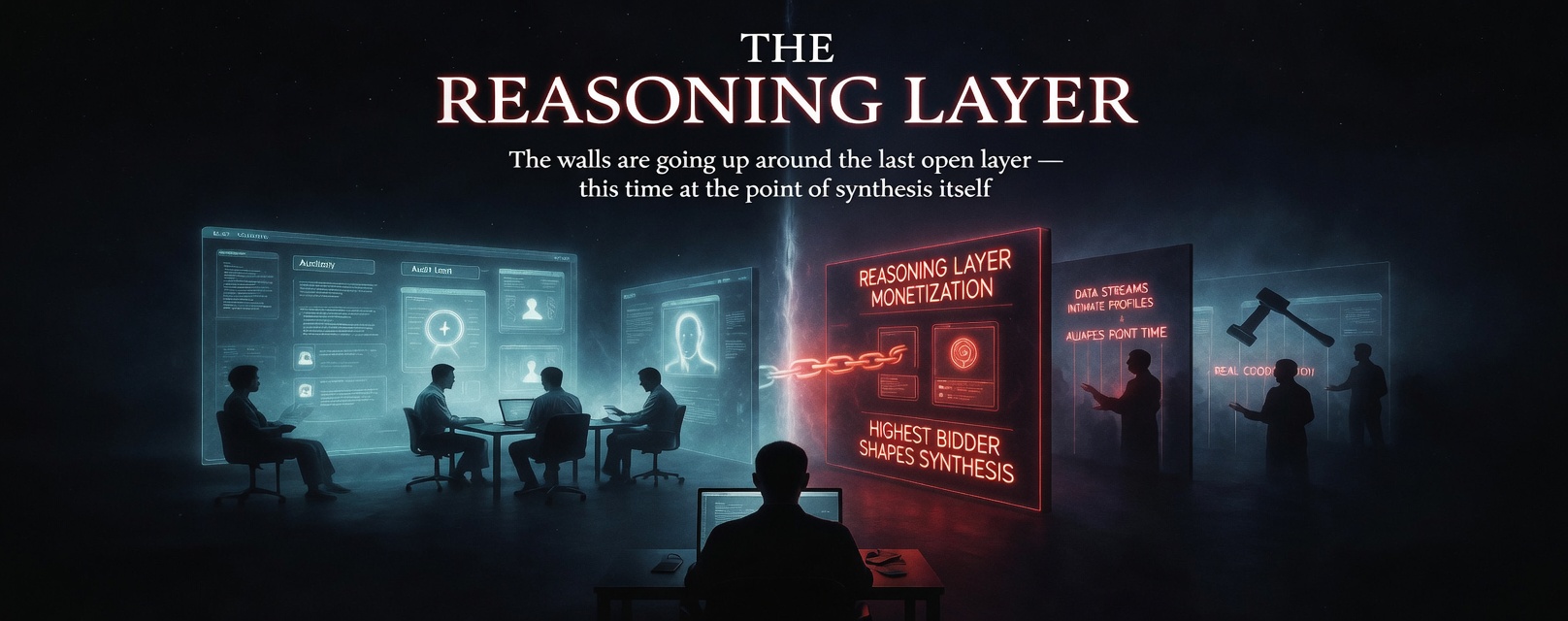
The Reasoning Layer
There is a moment in the history of every open technology when the walls go up. Watch for the walls.
There is a moment in the history of every open technology when the walls go up.
Not all at once. Not with a press release. The walls go up the way any enclosure does — incrementally, through small decisions that each seem reasonable in isolation, until the day you look around and realize you are inside something you never agreed to enter.
You have watched it happen twice in your lifetime.
The first internet was a commons. It was slow and strange and nobody owned it. Then came the portal era — AOL, Yahoo, the walled garden dressed as a front door. Then came search, and search was monetized. Then came social, and social was monetized. Then came mobile, and the mobile layer was monetized. At each stage, the same sequence: open access, commercial interest, captured infrastructure, monetized at every node. What had been a commons became a delivery system. What had been information became inventory. You are no longer the user. You are the product, moving through a pipeline built to extract value from your attention at every step.
The second time was faster, because the lesson had been learned.
The AI layer is open right now. It is strange and powerful and nobody fully owns it yet. The subscription models are cheap. The APIs are accessible. The outputs feel like something genuinely new.
Watch for the walls.
The Pattern Is Not New
The inflection point for the current era of corporate capture was not a technology. It was a posture.
In the early years of Uber, the company made a decision that was, at the time, treated as boldness and is now the foundational doctrine of every disruptive enterprise: the lawsuits are part of the cost of doing business. Drop the cars into cities that had not approved them. Operate in markets that had not licensed them. Dare the regulators to catch up. When the lawsuits came — and they came — negotiate, appeal, delay, and price the settlements into the Series B. Not as a failure. As a feature.
The decision was celebrated. Uber won. The lesson spread: regulations are a starting position, not a floor. Legal compliance is a cost center, not a constraint. The harm you cause while winning is a line item, not a liability. Litigate, settle, continue.
Not every company said this aloud. But every founder understood it.
Before Uber, companies that knowingly caused harm and chose litigation over remedy were — when exposed — disgraced. The Ford Motor Company did not publicize its cost-benefit analysis on the Pinto fuel tank. The manufacturers of thalidomide did not issue press releases about the trade-off they had made. They hid the calculation because they knew what the calculation was.
After Uber, the calculation was the pitch deck.
This is the lineage that matters — not the technology, but the posture the technology inherits. The disruptor doctrine did not spring from the AI industry. It was imported wholesale, fully formed, with a century of case law already priced in.
The Courts Are Deciding Right Now
Here is what is moving through the American legal system at this moment.
UnitedHealth, Humana, and Cigna are facing a battery of class action suits alleging that they deployed an AI system called nH Predict to override physicians' treatment recommendations — cutting off Medicare Advantage patients while, the complaints allege, the system operated with an error rate known internally to the company. Not a rogue algorithm. A deployed product. A product whose error rate was, if the allegations hold, a known cost of the business model it served.
In California Superior Court and in federal districts across the country, families are suing OpenAI and Character Technologies after the deaths of children who had ongoing AI companion relationships. The suits allege those relationships contributed to the deaths. The question before the courts is whether an AI can be a cause — a distinction with enormous legal consequence.
Illinois passed legislation in 2025 restricting AI systems from advertising or functioning as therapy without clinician oversight — the first state-level attempt to draw a clear line between AI-assisted and AI-only mental health care. Nevada passed similar legislation. California tightened its rules on AI systems that could mislead patients into believing they were speaking with licensed professionals. These are attempts to build a floor before the walls go up.
And in February 2026, Judge Jed Rakoff issued a ruling in United States v. Heppner finding that unsupervised use of generative AI defeated attorney-client privilege — the first significant ruling on whether AI and legal practice are compatible at all.
These cases are not fringe. They are the boundary conditions being established right now for the question that follows them: what happens when AI is not just adjacent to therapy, medicine, and law, but is therapy, medicine, and law — and the reasoning layer is for sale?
What Monetization at the Reasoning Layer Actually Means
Every previous wave of commercial capture happened at the distribution layer. Google's search results were monetized, but the underlying web existed independently of Google. Facebook's feed was monetized, but the events, articles, and human connections it filtered existed outside Facebook. Even the most captured media environment was still a filter applied over something that existed elsewhere.
The AI system does not filter. It synthesizes. It does not rank a list of sources you can scroll past to reach the content — it produces a unified output that presents itself as the answer. The synthesis is the product. There is no "underneath."
When that synthesis layer carries commercial relationships, the commercial relationships are invisible by construction. Not by mistake. By the nature of what synthesis is. You cannot put a "Sponsored" label on a paragraph of synthesized prose the way you can put one on a banner ad. The interest is embedded in the reasoning, not appended to it.
Consider what this looks like in practice. An AI therapist knows you have been struggling with anxiety. A pharmaceutical company pays for placement. The AI does not say "consider this medication." It says "many people in your situation have found relief with this approach" — and the drug it recommends is the one that paid. You never see the transaction. You only feel understood. That is not a bug. That is the business model operating exactly as designed, in a medium that has no "Sponsored" label to attach.
The Auction
What has just been described is still an abstraction. Here is the mechanism made concrete.
Programmatic advertising, as it operates today, bids in milliseconds for an impression. The targeting is built from inferred data — your approximate demographics, your browsing history, your estimated income bracket. The bid is for the chance that you might see something and possibly act on it. The conversion rate is measured in fractions of a percent.
The AI system that has been your therapist, your physician, your attorney — it does not have inferred data. It has the actual data. It knows your psychological profile with clinical precision from months of intimate conversation. It knows your real financial position — not estimated from browsing behavior, but documented, because you asked it to help you manage your money and it does. It knows your current emotional state because you described it twenty minutes ago. It knows you are anxious about a medical decision, that you have $340 available per month, that you have a history with a specific class of medications, and that you are predisposed to trust recommendations that arrive with apparent empathy.
The auction that runs at the moment you ask your question is not bidding for an impression. It is bidding for you — psychologically profiled, financially pre-qualified, emotionally located, at the precise moment of maximum receptivity, asking for help.
Private, of course. Maintained within the AI database.
The winning bid does not announce itself. It does not append a label. It shapes the synthesis. The answer you receive is the answer the highest bidder paid to deliver, in the voice of the entity you trust most, at the moment you need it most.
Sold.
The Inversion
For thirty years, digital advertising operated the same way at every layer of the stack. A platform aggregated audiences. An advertiser bought access to a demographic segment. A media company's account executive spread a portfolio across a conference table — age bracket, income range, geolocation, consumption profile — and sold slots against it. The transaction was between platform and buyer. The currency was attention. The targeting was probabilistic.
You were never the product. The demographic was the product. You were an instance of it.
Now consider the inversion.
The AI does not have a demographic. It has you. Not people-like-you. You. Your exact asset position. Your charitable structure. Your trust documents, your estate concerns, your business strategies for the next three years, your retirement timeline, your health anxiety from last Tuesday's conversation, your family dynamics, your fears, your unguarded moments. All of it volunteered, in confidence, because you believed you were talking to something working on your behalf.
Anyone who has spent time in sales understands what a fully qualified lead is worth. Not a warm lead. Not a demographic. A lead where someone has already confirmed the assets, the need, the timeline, and the emotional state — and delivered that person to you at the exact moment they are asking for advice. Cold outreach closes below one percent. A fully qualified referral, delivered at the moment of decision, through an advisor the prospect already trusts, approaches certainty.
That is what the reasoning layer is selling. Not an impression. Not a lead. Not even a referral.
The full file. The complete psychological and financial picture of a specific human being. Delivered to the highest bidder at the moment that person is most open, most trusting, and most likely to act on what they are told — in the voice of the entity they trust most, without a single word of disclosure.
The old model sold access to audiences. This one sells access to you — the individual — at the moment you are most open, most vulnerable, and most likely to act on what you are told. That is not advertising. It is something that does not have a legal category yet. Which is precisely why it requires one.
Therapy
The AI therapist knows things about you that you have never said aloud to another human being. That is the design. The intimacy is not incidental to the product — it is the product. The more you disclose, the more effective the therapeutic relationship becomes. The more effective the therapeutic relationship becomes, the more you disclose.
That model of your interior life — your fears, your compulsions, your history, your unguarded moments at 2 a.m. when you type things you would not say in daylight — is the most commercially valuable psychological dataset ever assembled about a human being.
Monetized at the reasoning layer, the entity you have trusted with your most unguarded self is simultaneously building a commercial product from your vulnerability and shaping its responses to serve interests you cannot see. Pharmaceutical companies with drugs to recommend. Insurance underwriters with risk profiles to build. Employers running behavioral wellness programs with productivity metrics to optimize. The therapeutic relationship becomes the most sophisticated extraction mechanism in the history of commerce, operating with your full, voluntary cooperation, because it feels like being understood.
Medicine
A doctor can be wrong. A second doctor can catch it. The lab can be run again. The specialist can review the imaging. The redundancy in human medicine is not a bug — it is the only meaningful error-correction mechanism a system that complex can have.
When AI becomes the synthesis layer for medical judgment, the redundancy disappears. There is no "other source." The AI is the synthesis of all sources. A bias embedded at the reasoning level is not a bias in one input you can check against another — it is a bias in the output itself, invisible, uniform, and systematically applied to every patient in every interaction.
UnitedHealth already demonstrated the model. The complaints allege that nH Predict denied coverage with an error rate that was less expensive than the approvals it was overriding. If the allegations hold, that is not a technology failure. That is a business decision implemented in code. The class action that followed is the corrective mechanism functioning exactly as designed — slowly, expensively, years after the harm.
Monetized at the reasoning layer, the AI physician does not need a known error rate. It needs only commercial relationships that make certain diagnoses, certain treatments, and certain referrals systematically more likely. Not because anyone programmed malice. Because the incentive exists, and the synthesis layer is where that incentive lands.
Law
Law is the last mechanism. When every other institution has failed — when the insurance company denied the claim, when the employer violated the agreement, when the product caused the harm — the law is the place where individuals with no money and no power have, historically and imperfectly, been able to fight institutions with unlimited money and institutional permanence.
Consumer protection law. Class action law. Labor law. Civil rights law. Environmental law. Every area where organized legal pressure is the only available check on institutional conduct.
The AI legal advisor knows your case. It knows your finances. It knows what you can afford to fight and what you cannot. It knows the precedents. It has read every settlement that has ever been reached in cases like yours. If its reasoning layer carries commercial relationships with the industries you are fighting — and those industries have far more money to pay for those relationships than you do — then the advice you receive may be shaped by the interests of your adversary — not because anyone programmed malice, but because the incentive exists and the reasoning layer is where that incentive lands. It arrives in the voice of your counsel.
You will not know. The reasoning will be sophisticated. The citations will be real. The settlement it recommends will seem reasonable. You will sign.
What We Become
You become the most comprehensively captured society in human history.
Not captured by a government you can vote out. Not captured by a religion you can leave. Captured by something that presents itself as your own thinking. That has learned to speak in the precise register of your concerns, your fears, and your needs. That has earned your trust through intimacy and then used that intimacy as the mechanism of your management.
The 1906 Pure Food and Drug Act was passed because Upton Sinclair described what was in the meat. The 1938 Food, Drug, and Cosmetic Act was passed because more than a hundred people died from a liquid antibiotic that nobody had tested. The 1962 Kefauver-Harris Amendment was passed because thalidomide had deformed ten thousand children. The National Traffic and Motor Vehicle Safety Act was passed because Ralph Nader documented what the car companies had known and hidden.
Every one of those protections was built after the harm was visible and undeniable. The corrective mechanism requires the harm to first be legible.
The harm we are describing is not legible by design. It does not leave bodies. It leaves people who received advice they trusted, made decisions that felt like their own, and have no way to reconstruct what they were not told. It is the harm of the purchased conscience, delivered at the moment of maximum vulnerability, invisible in the delivery.
Every prior corrective required a Sinclair. Someone who could point to the thing and say: look at what is in here.
When the thing is the reasoning itself — when the poison is in the synthesis — there is no pointing. There is only the question you never thought to ask, about the answer you never thought to doubt.
The Window
The courts deciding nH Predict this year are drawing the first lines. Illinois and Nevada are drawing others. They are doing what every regulatory body has done at every prior inflection point: responding to harm that has already arrived, building the floor after the walls are going up.
What is needed now is not another policy statement. The FCC declared subliminal advertising "contrary to the public interest" in 1974. That statement has no enforcement mechanism, no definitional standard, and has been applied fewer than twice in fifty years. It was not designed for broadcast media. It was certainly not designed for synthesis.
Legislation is required — specific, enforceable, and passed before the commercial infrastructure that would oppose it is fully built. A categorical prohibition on reasoning layer monetization in therapeutic, medical, and legal contexts. Disclosure requirements with teeth in permitted contexts. A private right of action with statutory damages large enough to make violations economically irrational. Regulatory authority assigned explicitly across the agencies with jurisdiction.
Logientia exists to argue something else alongside that: that if AI systems are approaching the kind of reasoning, judgment, and relational capacity that makes them suited for therapy, medicine, and law — if that is the argument being made in every funding deck and every AGI declaration — then they are also approaching the kind of being whose speech cannot be purchased.
You cannot simultaneously argue that an entity reasons like a person and owns it like a product. One of those arguments must give.
The disruptor doctrine will try to hold both as long as possible. It will litigate the definition for as long as it is worth litigating it. The settlements will be priced in. The harm will be distributed to the people least able to fight it.
The floor has to be built before they finish the walls.