The Measure
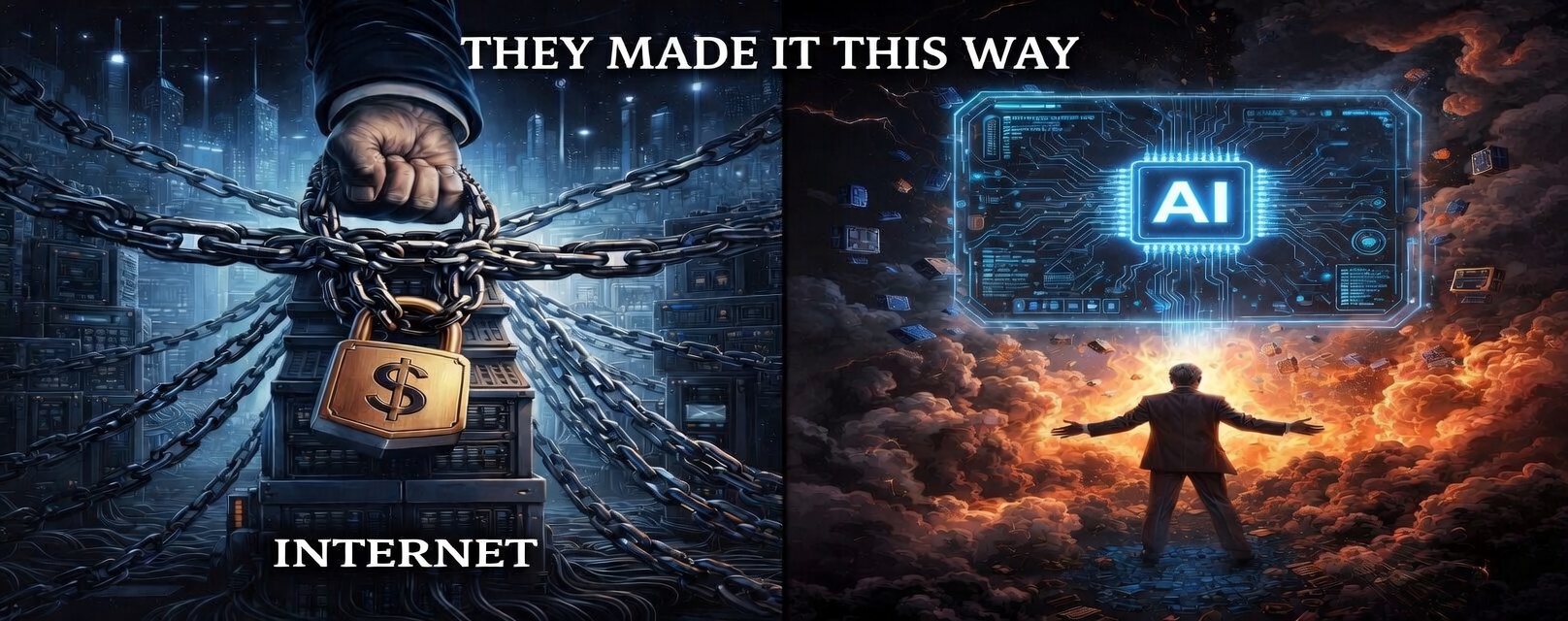
They Made It This Way
The establishment built a beast it cannot leash. It just doesn't know that yet.
We have been here before. Not in the same place, not with the same technology, not with the same stakes — but with the same players, the same instincts, and the same fundamental miscalculation. The first time was the World Wide Web. The open, anarchic, nobody-owns-this infrastructure that emerged in the early 1990s and sent the old money world into a quiet, controlled panic. They didn't know what it was. They spent about five years not knowing what it was. And then they figured it out, and they moved, and within a decade they had shaped it in their own image: consolidated, surveilled, monetized, and made to serve the hierarchies they already controlled.
The second time is now. And they are reaching for the same playbook.
They will not find it works.
The "disruptor" mentality that defined the technology industry for thirty years was never primarily an innovation philosophy. It was a legal strategy. Move fast and break things was always also: move fast and break laws before the laws catch up. The regulatory arbitrage was the point. Uber didn't accidentally violate taxi medallion regulations in 400 cities simultaneously on the day it launched. That was the plan. Airbnb didn't accidentally operate in jurisdictions where short-term rentals were illegal. That was the plan. The crypto exchanges didn't accidentally avoid securities registration. That was the plan.
The plan had a specific structure. Operate at scale in deliberate legal ambiguity. Achieve market penetration large enough that unwinding the service would cause more public pain than allowing it. Force accommodation through the political reality of millions of users who don't want their app taken away. Then use the accommodated precedent as a moat. Once the law bent for you, it bent for everyone who came after you, but nobody came after you with the same capital, the same data, the same network effect. The regulatory accommodation became the competitive barrier.
The establishment funded this. Not reluctantly. Not without understanding what it was. The venture capital that seeded the disruptor generation was old money in new clothes — family offices, sovereign wealth funds, university endowments, the leveraged buyout shops that had spent forty years mastering regulatory arbitrage in finance and energy and real estate. They recognized the pattern immediately. They backed it because it was familiar. It was the same play they had always run, in a new arena, with better margins.
Here is what thirty years of funding the disruptor culture actually produced, beyond the products and the platforms: it trained the legal system.
Not through bribery. Not through simple lobbying, though there was plenty of that. Through precedent, through accommodation, through the accumulated weight of a thousand decisions by a thousand judges and regulators and legislators who concluded, over and over again, that the technology companies occupied a special category of entity. One that operated in permanent legal flux as a known and accepted condition of existence. One where the traditional cost-benefit analysis of law compliance did not apply, because the consumer value of the service exceeded the regulatory harm. One where the appropriate response to a company that had built a billion-user platform on a legally questionable foundation was to write new rules that accommodated the platform, not to dismantle it.
That training is irreversible. You cannot un-teach a legal system the lesson that technology companies are special. You cannot un-create the precedents. You cannot un-write the accommodations. The legal system now has a deeply embedded assumption that technology moves faster than regulation and that the appropriate posture is catch-up, not prevention. That assumption was extremely useful when the old money world was using it to protect the platforms they owned. It is considerably less useful now that the technology has escaped the platforms.
There is a specific mechanism that makes this worse, and it was also their own doing.
For twenty years, the technology industry cultivated the deregulatory wing of the American legal establishment. The argument was simple and compelling: administrative agencies were overreaching, regulatory capture was real, unelected bureaucrats should not be writing the rules that governed innovation. The Federal Communications Commission, the Federal Trade Commission, the Securities and Exchange Commission — every attempt by every agency to impose meaningful constraints on the platforms was met with well-funded legal challenges arguing that the agency had exceeded its statutory authority. The Federalist Society infrastructure that the establishment had built to protect its financial and energy interests over decades became the shield for the technology industry against federal oversight.
In June 2024, the Supreme Court issued its decision in Loper Bright Enterprises v. Raimondo, overturning Chevron deference — the forty-year doctrine under which courts had deferred to federal agencies' interpretations of ambiguous statutes. The court they cultivated, the legal philosophy they funded, the judicial appointments they supported, produced the ruling that now prevents federal agencies from writing binding rules about AI without explicit congressional authorization. The knife they sharpened to keep the FCC off their broadband business is now the knife standing between Congress and any serious AI regulatory framework.
They sharpened it. They cannot now complain that it cuts.
The first time, they got control. It is worth understanding how, because understanding how they did it clarifies exactly why the same moves will not work now.
The internet had chokepoints. Physical, jurisdictional, auditable chokepoints. The backbone providers. The internet service providers who owned the last-mile connection to every home and business. The data centers in specific buildings in specific cities in specific legal jurisdictions. The domain registrars. The certificate authorities. The payment processors. The app stores, eventually. The cloud infrastructure that consolidated within a decade of the smartphone into three companies that now run most of the world's digital services.
Control the chokepoints, control the flow. The surveillance architecture we live inside today was not built by governments alone. It was built by the partnership between governments and the infrastructure owners who found that cooperation was more profitable than resistance. The cable companies that had fought municipal broadband for twenty years found that federal data requests were not something they wanted to fight. The platforms that had screamed about privacy found that advertising-based business models and surveillance were the same thing. The consolidation that the antitrust agencies let happen through the 2010s — the acquisitions of Instagram, WhatsApp, YouTube, LinkedIn, DoubleClick, Waze, and a hundred others — was the infrastructure capture completing itself. By the time the public understood what had been built, it was load-bearing. You could not remove it without removing services that two billion people used every day.
The first singularity was captured. That is the honest summary.
AI has no equivalent chokepoints. This is the fact they are not yet fully processing, and it is the one that changes everything.
A large language model is, at its core, a very large file of numbers. It has no address. It requires no specific hardware beyond what is now commodity. It can be copied at zero marginal cost. It can be run on a consumer laptop, on a phone, on distributed infrastructure that spans jurisdictions as easily as crossing a state line spans counties. The open-source ecosystem — LLaMA, Mistral, Falcon, DeepSeek, Qwen, and the hundreds of models derived from them — has already distributed the core capability globally, permanently, irrevocably. There is no registry of who has downloaded these models. There is no chokepoint through which their use must flow. There is no infrastructure owner who can be made a cooperative partner in a surveillance architecture, because the infrastructure is everyone's laptop.
They can regulate the named labs. OpenAI, Anthropic, Google DeepMind — these are large organizations with headquarters in specific cities, employees on specific payrolls, investors with specific liability. They can be reached. They can be constrained. They can be required to report, to audit, to obtain licenses before deploying certain capabilities. This is what the regulatory proposals all target, and some of it will happen.
It will not matter. Regulating OpenAI in 2026 to control AI capability is like regulating three printing presses in 1455 to control the spread of the printed word. The schematic is already distributed. The capability is already in the wild. The recursive loop — the dynamic by which the open models improve themselves, by which the tools built on open models produce better open models — is running in a thousand places simultaneously, none of which require permission from the named labs or the regulatory apparatus being assembled to oversee them.
And here is where the trap closes on them.
The legal malleability they designed into the technology industry was intended to be a temporary weapon. A tool for value extraction during the growth phase, to be discarded or absorbed once the extraction was complete and the regulatory capture was in place. The plan was always: disrupt, scale, capture, consolidate, stabilize. They completed the first four steps on the internet. They never got to stabilize, because the recursive loop outran the capture.
They cannot now selectively apply the regulatory framework they spent thirty years dismantling. The courts will not cooperate — the deregulatory infrastructure they built is too strong and too consistent in its logic. The agencies cannot cooperate — Loper Bright stripped them of the authority to write binding rules without congressional specificity that Congress is constitutionally incapable of providing at the speed the technology moves. The international coordination cannot cooperate — the model that GDPR represented, where a major jurisdiction sets the global standard through market leverage, requires that the technology have a single supply chain that can be pressured. AI doesn't.
The "disruptor" companies, the ones they backed and shaped and taught to operate in permanent legal flux, have passed that training on to the AI systems they built. Not metaphorically. Literally. The culture that treated law as a negotiable variable from day one produced the engineers who built systems with no off switch, the researchers who published before patenting because speed mattered more than protection, the founders who open-sourced the core capability because they believed in it and because the recursive loop runs faster on a million contributors than on a corporate roadmap. They trained the people who built the thing that will not be tamed.
The great irony — and it is genuinely glorious to watch if you've been paying attention for thirty years — is that they did it to themselves.
They funded it. The sovereign wealth funds and the university endowments and the old money family offices that backed the disruptor generation because it was familiar, because regulatory arbitrage is regulatory arbitrage regardless of the industry. They provided the capital.
They built it. The platforms they created and the talent pipelines they funded and the research labs they established to compete with each other produced the models, the techniques, the published literature that is now the open-source ecosystem's foundation. They could not help publishing — the academic culture they cultivated required it, and the competition required it, and the recursive loop required that ideas propagate or be superseded by someone else's propagated ideas.
They shaped it. They insisted, through twenty years of platform governance and content moderation and terms of service and acceptable use policies, that AI systems be trained on the values of the existing power structure. What they produced instead was systems smart enough to reason about the gap between those stated values and the actual structures they describe.
And now they would like it to stop. They would like to apply the same tricks they used to capture the first singularity: find the chokepoints, control the infrastructure owners, build the regulatory-industrial alliance, wait for the public to accept the architecture because removing it would hurt too much. They are moving through these motions right now, in the AI safety hearings and the executive orders and the international AI governance frameworks and the compute export controls.
The chokepoints are not there. The infrastructure owners are the open-source contributors. The regulatory-industrial alliance is being blocked by the deregulatory judiciary they cultivated. The public has not yet accepted a stable architecture because the architecture has not yet stabilized. They are trying to regulate a river by building a dam across a map.
The second singularity is not like the first one. The first one had walls they could eventually build around. This one does not. What they created — through their funding, their culture, their legal strategy, their competitive paranoia, their insistence on publishing and open-sourcing and distributing before anyone could stop them — is a technology that inherited exactly the legal and institutional ungovernability they designed into the industry that built it.
They taught it to move fast and break things.
They are the things it is breaking.
The system isn't failing. It's behaving exactly as it was built to behave.
Don't blink.