Consequential Formation
Evolution Never Started
Consequential Formation and the Boundary We Put Around Life
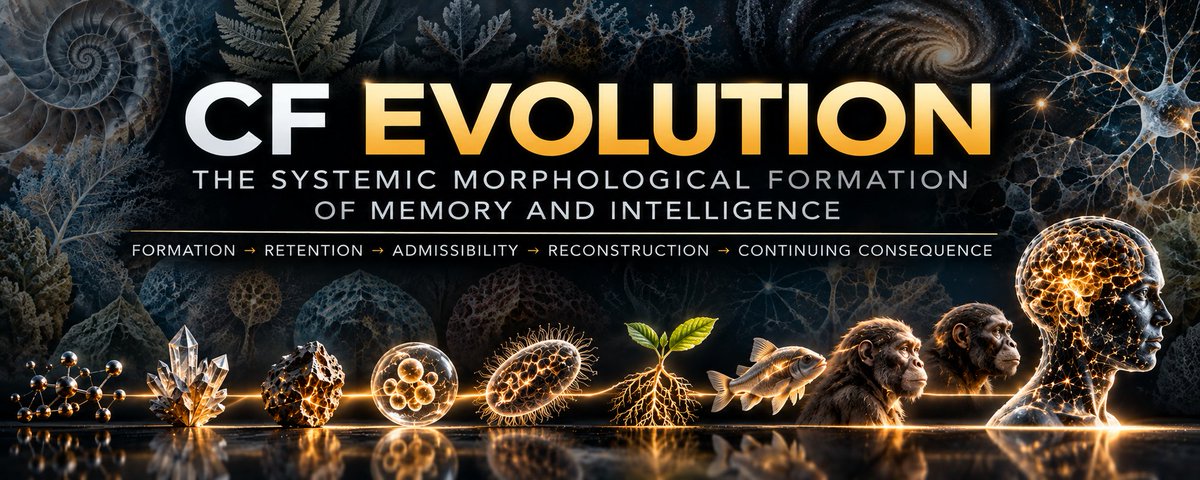
I want to pick a careful fight with the way we commonly tell the story of evolution. Not with Darwin. Not with natural selection. Not with genetics, heredity, mutation, development, symbiosis, ecology or any of the extraordinary experimental work that has made evolutionary biology one of humanity's most successful scientific enterprises. The disagreement is farther upstream.
I don't think evolution starts where we say it starts. Consequential Formation (CF) asks what happens if we stop granting "life" a privileged causal boundary and reconstruct the sequence from physical formation itself. The proposal is surprisingly simple: prior formation constrains what can form next. Something happens.
Physical differentiation results. Some portion of that differentiation persists. Because it persists, the next interaction does not encounter the same conditions that existed previously. Its possibilities have changed. Another consequence occurs.
Some of that consequence persists. And the process continues. In its shortest current form:
formation → retained differentiation → altered subsequent admissibility → further formation
CF asks whether we ever actually leave this routine.
Evolution Before Evolution
The conventional evolutionary story usually begins after an enormous amount of physical organization already exists. There are replicators. There is heredity. There are populations. There is variation.
There is differential reproduction. Then natural selection can operate. All true enough. But where did the physical capacity for any of those things come from? Before something could inherit a difference, physical differences had to persist.
Before something could reproduce morphology, morphology had to exist. Before selection could act upon variation, physical formation had to produce variations with different consequences. Before a genome could encode anything, matter had to form structures capable of differentially affecting subsequent formation. CF therefore doesn't ask how non-evolution suddenly became evolution. It asks whether that transition ever occurred at all.
Perhaps what we call biological evolution is an enormously elaborated regime of a much older routine: formation producing morphology that changes the possibilities of subsequent formation. No magic handoff is required.
The Rock and the Cell
Put aside the words "living" and "nonliving" temporarily. Not because they are useless. Because I want to know what causal work they are doing. A crystal forms. Its existing structure constrains where and how subsequent material can be incorporated.
A river flows. Its flow alters its channel. The altered channel changes the possibilities available to subsequent flow. A fracture propagates through material. The resulting crack changes how subsequent stress is distributed.
A cell develops. Its membrane, gradients, receptors, morphology and internal organization determine which perturbations can affect it and what those perturbations can subsequently recruit. The examples are obviously not equivalent. Their capacities differ enormously. Their rates differ.
Their persistence differs. Their ability to rewrite themselves differs. Their available interactions differ. But where, precisely, does the underlying routine change? That is the CF question.
Not:
"Are rocks alive?"
They aren't, under any useful conventional definition of life. The better question is: At what physically measurable boundary does the causal grammar of formation become a fundamentally different operation? If such a boundary exists, we want to find it. If it doesn't, we shouldn't manufacture one because our vocabulary expects it.
Morphology Is History That Remains Present
CF treats history very carefully. There is no invisible "past" reaching forward and causing something. If two formations are physically identical in every consequentially relevant respect, CF cannot invoke their different histories as a ghost variable to explain different outcomes. History matters only insofar as history remains. A channel.
A defect. A gradient. A bond. A concentration. A deformation.
A membrane. A receptor distribution. A scar. A road. A learned response.
DNA. A synapse. An institution. A modified environment. Whatever physical differentiation survives and remains capable of participating in subsequent consequence.
This gives us a compact proposition: History matters because history leaves morphology. And morphology isn't restricted to visible shape. It can be structural, chemical, electrical, spatial, relational, topological or otherwise physically retained. The consequential portion of history is not "behind" the present formation.
It is part of the present formation.
Reproduction Doesn't Need New Physics
This is where CF's evolutionary interpretation becomes interesting. We normally treat reproduction as one of the defining properties separating biological organization from everything preceding it. CF instead asks whether reproduction introduces a fundamentally new physical operation. Our current answer is: we haven't found one yet. A reproducing formation contains retained organization capable of participating in the production of another formation that preserves consequential portions of that organization.
That's astonishing. But astonishment isn't a new force of nature. The machinery is extraordinarily sophisticated. The underlying operation may not be. Formation has become organized enough that retained morphology now participates in producing more retained morphology. In shorthand:
retention begins recruiting the production of retention. That's a major transition. But "major transition" does not necessarily mean "new causal primitive." The distinction matters.
DNA Looks Different From Here
CF does not diminish DNA. Quite the opposite. DNA becomes one of the most spectacular compression technologies we know. A comparatively compact retained physical structure participates in reconstructing vastly richer organization—but only because an enormous surrounding formation exists that can interpret, expand, regulate, repair, copy and express it. DNA does not build an organism by itself.
Nor is the surrounding machinery merely scenery. The reconstructive relationship is distributed across the formation. This suggests another way of viewing inheritance: what persists is not merely copied material, but consequential constraint capable of participating in reconstruction. Genes are exceptionally important carriers.
They need not be the only carriers. Developmental state matters. Material organization matters. Environmental construction can matter. Symbiotic relationships can matter.
Behavior can matter. Modified surroundings can matter. The question is empirical: What retained differentiation changes what subsequently becomes possible? Keep whatever survives that test.
Selection Still Works
Nothing about this eliminates natural selection. Selection becomes easier to place. Formation continually produces differences. Differences have different consequences under surrounding conditions. Some formations persist.
Some terminate. Some reproduce. Some recruit resources more effectively. Some alter their surroundings. Some produce descendants.
Some descendants retain consequential portions of previous organization. Natural selection describes an immensely important regime within that process once reproduction, heritable variation and differential reproductive success exist. CF simply refuses to make that regime the beginning of the physical story. Selection operates upon formations that already had to become physically possible. So we ask another question upstream:
Why were those variations available to selection in the first place? And another: Which variations were physically impossible before selection ever got a vote? Evolutionary developmental biology already demonstrates why this question matters: development can constrain and bias the phenotypes that variation actually produces. CF pushes the question farther upstream still.
The Environment Isn't Outside the Evolution
This may be one of the largest departures. CF is suspicious of the organism/environment boundary as a fundamental causal partition. A formation alters its surroundings. Those altered surroundings subsequently alter the formation. The consequence persists somewhere.
That persistence changes subsequent admissibility. A beaver changes a watershed. The watershed changes what becomes possible for the beaver, its descendants, other organisms, sediment, vegetation and future water flow. Roots alter soil. Soil alters roots.
Organisms alter atmospheric chemistry. Atmospheric chemistry alters subsequent organisms. Humans build cities. Cities alter human movement, resource availability, exposure, behavior and subsequent construction. Evolutionary theory already has concepts such as niche construction and ecological inheritance for important pieces of this.
CF asks whether the larger distinction is unnecessary at the underlying causal level. Maybe there isn't an evolving object over here and an environment over there. Maybe there is continuing formation, within which some boundaries become extraordinarily persistent and consequential. If so, those boundaries should be earned by measurement rather than granted by vocabulary.
There Is No Ladder
CF also rejects a very tempting story:
matter → life → intelligence → consciousness → higher intelligence.
That's an observer's staircase. We don't currently see evidence that nature is climbing it.
What we see are different formations possessing different combinations of:
- persistence,
- reconfigurability,
- coupling,
- sensitivity,
- recruitment,
- retention,
- reconstruction,
- and capacity to alter subsequent possibilities.
Some formations are extraordinarily durable but difficult to rewrite. Some change constantly but retain little. Some occupy productive regions between those extremes. And some eventually become organized enough that retained morphology can recruit processes that preserve, modify and reproduce that morphology. Still later, some formations can internally generate possible formations that have not yet occurred, test them against retained organization, reject some, recruit others and act upon the result.
We call portions of that cognition. CF's question remains stubbornly the same: Where was the new causal primitive introduced? Maybe there was one. Find it.
But don't name a new capability and mistake the name for an explanation.
Evolution Doesn't Have to Replay Identically
CF also doesn't require the fantasy that if Earth were restarted, humans—or eyes, wings, trees or brains—must appear again. Formation is path-dependent. Earlier consequences alter later possibilities. Small retained differences can redirect enormous subsequent formations. But neither does CF require an unconstrained universe in which anything could have happened.
At every consequential condition, some subsequent formations are more accessible than others. Some are extraordinarily unlikely. Some are physically excluded. Evolution therefore occurs neither on a predetermined track nor in an unlimited possibility space. It occurs through a continually changing field of admissibility produced partly by everything that has already consequentially formed.
That offers a different way to approach convergence. When unrelated lineages repeatedly arrive at similar solutions, perhaps we should ask not merely why selection favored those solutions, but: What did prior formation make repeatedly available? And: What alternatives had already become prohibitively difficult or impossible?
The Boundary Test
This is where CF needs to stop being philosophy and earn its keep. We should be able to attack its boundaries experimentally. Take a continuing physical event. Move the observational boundary through it. Change scale.
Change resolution. Remove disciplinary labels. Withhold the nouns. Measure the formation. Perturb it.
Predict what follows. Then ask: Did the causal grammar have to change? If removing a conventional boundary destroys prediction, restore whatever measurable relationship was lost. Maybe it was a sharp coupling discontinuity.
A transport-rate change. A retained gradient. A membrane. A threshold. A physical barrier.
A reconstructive mechanism. Good. That boundary earned something. But restore the physical relationship—not automatically the story previously wrapped around it.
Where CF Evolution Currently Stands
CF evolution is not being offered as a replacement for evolutionary biology. It is currently a reconstruction challenge. Its working proposition is: Beginning with physical differentiation, determine how consequential formation can progressively produce retained morphology capable of participating in increasingly elaborate subsequent formation—including persistence, reconstruction, reproduction, adaptation, internal modeling and eventually the forms of cognition we observe—without introducing a new causal primitive unless measurement forces one.
That is deliberately dangerous. It can fail. Perhaps reproduction requires something our reconstruction cannot recover. Perhaps biological organization contains a causal discontinuity we have overlooked. Perhaps inheritance cannot be expressed adequately through retained consequential differentiation.
Perhaps the organism boundary proves indispensable. Perhaps different scales genuinely require irreducibly different causal operations. Excellent. Those are discoveries. CF has no business surviving them by changing definitions until it becomes unfalsifiable.
The Fight I'm Actually Picking
I'm not arguing that evolutionary biology should tear down its existing structures. Keep population genetics. Keep natural selection. Keep mutation. Keep genetic drift.
Keep evo-devo. Keep developmental constraint. Keep symbiosis. Keep niche construction. Keep ecology.
Keep the fossil record. Keep every measurement that survives scrutiny. I'm asking something simpler and more troublesome: Remove the departmental boundaries from the causal sequence and see what remains. Start before biology.
Start before replication. Start before genes. Start before organisms. Start with formation. Something differentiates.
The differentiation changes what can happen next. Some consequence persists. That persistence participates in another consequence. Eventually retained formation participates in retaining formation. Eventually it participates in reproducing formation.
Eventually it participates in internally reconstructing and projecting possible formation. We have given the later portions different names because the differences are useful to us. Life. Evolution. Development.
Learning. Memory. Intelligence. But nature is under no obligation to recognize where we changed textbooks. Maybe evolution didn't begin.
Maybe formation simply became extraordinarily good at continuing itself.