Machine Labor
Fractal Robotics
Don’t Build the Android. Automate the Room.
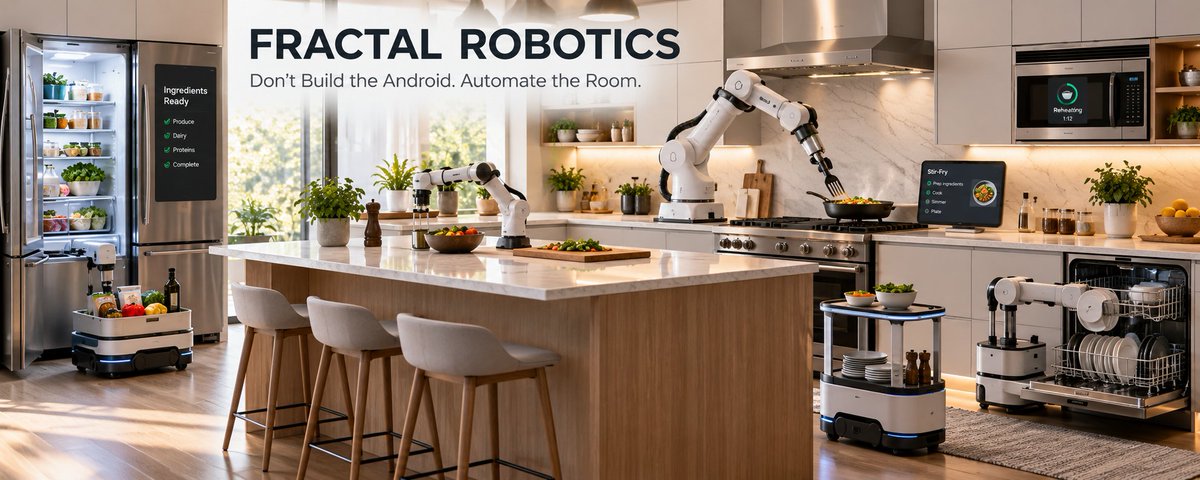
For decades, the popular robotics dream has been remarkably consistent: Build the machine that can do what a human does. Give it eyes. Give it hands. Give it legs. Give it memory. Give it intelligence. Teach it to recognize the world, manipulate arbitrary objects, navigate unfamiliar spaces, recover from mistakes, and eventually perform useful labor with little or no human involvement. It is an extraordinary engineering problem.
It may also be the wrong problem.
Fractal Robotics begins from a very different question:
- What if the intelligence does not have to live inside the machine at all?
- And what if the machine does not need to be intelligent?
- What if most useful machine labor could instead be produced by very ordinary automation—motors, lifts, conveyors, valves, shuttles, doors, dispensers, carts, actuators, ovens, pumps, tools and fixtures—temporarily coordinated by intelligence distributed through the computational devices already surrounding us?
Phones. Tablets. Computers. Building controllers. Networks.
Sensors. Dedicated edge devices. Whatever useful and authorized signals happen to be available nearby. The machine stays simple. The environment becomes addressable.
The intelligence becomes distributed. And the apparent “robot” may never need to exist at all. That is Fractal Robotics.
START WITH THE KITCHEN
Consider a deceptively difficult problem: Cook dinner. The conventional robotics solution is approaching it from the standpoint of a human replacement. Build a humanoid or similarly generalized robot capable of opening refrigerators, recognizing packaging, locating ingredients, handling knives, manipulating cookware, operating arbitrary appliances, identifying spills, moving dishes, loading a dishwasher and cleaning the room afterward. That requires extraordinary perception and generalized manipulation.
The robot has to solve the kitchen because the kitchen was built for humans. Fractal Robotics asks whether we can instead solve the kitchen. An automated refrigerator only needs to present an ingredient or container at a known transfer point. An automated microwave only needs a reliable loading interface. An oven needs machine-addressable racks or carriers.
A range can expose controlled cooking positions. A dishwasher can expose standardized loading geometry. A countertop preparation module can contain the messy operations. A low, stable shuttle can move carriers between stations. A few inexpensive lifts, slides, grippers, dispensers and transfer mechanisms handle the physical operations that actually require movement.
Now look at the required mechanical vocabulary:
- OPEN.
- CLOSE.
- LIFT.
- LOWER.
- TRANSFER.
- DOCK.
- ROTATE.
- DISPENSE.
- HEAT.
- HOLD.
- RINSE.
- DRAIN.
- STOP.
None of these operations requires a machine to understand dinner. The surrounding intelligence understands dinner. The machines understand their bounded capabilities. That distinction is the foundation of the program. Don’t build the android. Automate the room.
THERE IS NO ROBOT
This is important enough to state plainly. Under the architecture we are developing, there does not need to be a persistent entity called “the robot.” There is machinery. There are sensors. There are actuators.
There are deterministic local safety systems. And there is temporarily assembled cognition coordinating them. A mechanism does not need a personality, identity, mission, memory or internal worldview. A kitchen shuttle does not wake up in the morning believing itself to be Kitchen Robot Number 14. It accepts bounded commands.
It reports what happened. It stops when authority disappears. That is preferable. Fractal Robotics deliberately separates intelligence from machinery. A useful shorthand is:
Put sophistication in the shared cognition, simplicity in the machine, and authority at the boundary.
WHERE THE COGNITION COMES FROM
This is where Fractal Robotics connects directly to our larger work on cognition. We have been developing CF — Consequential Formation. CF is an attempt to reduce reasoning and historical reconstruction to a smaller relational grammar.
Instead of beginning with domain nouns—robot, refrigerator, tractor, patient, factory, organism, computer, vehicle—we ask simpler questions:
- What differed?
- What interacted?
- What changed?
- What persisted?
- What depends on what?
- Which retained consequences affect what happens later?
- Which distinctions actually matter under the present probe?
- Which ones can be removed without changing the outcome?
That matters enormously for distributed machine labor. If every industry requires intelligence to reason entirely in its own giant specialized ontology, then worldwide automation becomes an integration nightmare. Agriculture speaks one language. Manufacturing another. Hospitals another.
Warehouses another. Homes another. Transportation another. Energy another.
But underneath those vocabularies, a remarkably large amount of machine coordination can be expressed relationally:
- state changed;
- resource became available;
- route became blocked;
- temperature crossed threshold;
- carrier arrived;
- load departed;
- mechanism completed operation;
- expected consequence failed;
- authority expired;
- human intervention required.
This is why the reductive grammar matters. It is not merely philosophical compression. It may become a common intermediate language for physical coordination. The machine does not need to understand the human noun attached to every mechanism. It needs to understand what that mechanism can sense, what it can change, what conditions constrain those changes, and what consequences actually occurred.
APTD: THE DISTRIBUTED COGNITIVE NODE
One important part of the architecture is the APTD — Autonomic Persistence and Transition Device. An APTD is not a robot. It is a bounded computational/runtime node capable of participating in governed cognition and physical interaction. A modern phone is already an extraordinary candidate APTD. It contains compute.
Storage. Networking.
GPS/GNSS.
Wi-Fi. Bluetooth. Accelerometers. Gyroscopes. Magnetometers.
Cameras. Microphones. Barometers on many devices. Local timing. Authentication.
Battery-backed mobility. Secure hardware. And often a human carrying it through the physical world. A tablet can do the same. So can laptops, edge computers and dedicated devices.
Instead of manufacturing all required sensing and computation into every machine, Fractal Robotics can recruit nearby APTDs. Three phones in a room may provide several viewpoints, substantial compute, network diversity and environmental measurements. A tablet mounted on the wall may contribute another observation point. A local PC may contribute heavier computation. A dedicated controller may contribute deterministic timing.
When somebody leaves the room, that particular contribution disappears. When somebody enters, another becomes available. The cognitive formation changes dynamically. The machine itself does not care.
COMPUTE IS ONLY PART OF WHAT THE NETWORK PROVIDES
At sufficient scale, people could choose to contribute unused computing resources from phones, tablets or computers and receive compensation for doing so. But compute is only one resource these devices can provide. With explicit permission, devices can also contribute environmental observations. Movement. Orientation.
Radio conditions. GNSS quality. Wi-Fi topology. Bluetooth/BLE neighborhood. Barometric changes.
Magnetic disturbances. Local network availability. Machine telemetry. Other sensor-derived signals. Those observations can help the distributed cognition understand the field in which machinery is operating.
There is an important governance rule here: compute participation and sensor participation must be separately disclosed, permissioned and revocable. Do not hide sensing inside “compute rental.” That would create exactly the kind of hidden authority and hidden state problem this architecture is intended to eliminate. The useful network is one people can inspect and deliberately join.
CONNECTORDOME: THE TWO-WAY INTERFACE
The next major piece is ConnectorDome. ConnectorDome is the governed interface between the distributed cognition and whatever permitted signals and machine capabilities are presently available. Think of it as two asymmetric surfaces. One side is perception. The other is action.
They are not the same permission. Receiving information does not grant permission to change anything. In shorthand: observation authority != action authority
ConnectorDome therefore exposes something resembling:
- RECEPTOR PLANE
- ↕
- DISTRIBUTED COGNITION
- ↕
- ACTUATION PLANE
- The receptor plane says:
- Here is what may presently be observed.
- The actuation plane says:
- Here is what may presently be changed.
- An endpoint might advertise:
- what it can sense;
- what it can change;
- its physical operating limits;
- what authority is required;
- its expected latency;
- its current availability;
- its abort conditions;
- what telemetry it will return;
- what it does if communication disappears.
The intelligence never receives a magical button labeled CONTROL EVERYTHING. It receives narrowly defined capability edges.
A NURSING HOME AS A FIELD
A nursing home is a good example because it makes the difference between “robotics” and distributed cognition obvious. Imagine the permitted signal environment. Staff phones. Resident devices where explicitly authorized. Tablets.
Wi-Fi. Bluetooth and UWB positioning. Nurse-call systems. Door sensors. Elevators.
HVAC.
Bed and chair sensors. Lighting. Laundry systems. Cleaning equipment. Supply carts.
Building automation. Environmental sensors. Cameras in specifically authorized spaces. Wheelchairs and mobility equipment. Kitchen systems.
Emergency systems. The distributed cognition does not need to see an ontological object called NURSING HOME. It sees a changing field of relationships. A call signal appeared. A staff device is nearby.
An elevator is currently on another floor. A corridor is obstructed. A supply cart is available. A door reports closed. A cleaning mechanism reports unfinished work.
Two independent sensors corroborate movement. A room temperature changed unexpectedly. A machine failed to produce its expected receipt. ConnectorDome makes that field legible. Fractal Robotics makes selected mechanisms addressable.
CF provides the relational grammar for reasoning about what matters. The system might summon a supply cart, prepare an elevator, open an appropriately authorized door, notify staff, reposition equipment or schedule routine building operations. It does not become the nurse. It does not inherit medical authority merely because it can operate the elevator. Clinical decisions, medication, restraints and other high-consequence capabilities remain behind entirely different authority boundaries.
Again: observation is not establishment, and establishment is not authority.
CF-LOGIC: KEEPING POSSIBILITY SEPARATE FROM AUTHORITY
Another component is CF-Logic — Consequential Formation Logic. CF-Logic deals with warrant. Modern generative AI is extremely good at producing possibilities. That is valuable. The mistake is allowing a plausible possibility to silently acquire the same authority as something established through evidence.
Our current first rule is: No consequence may acquire more authority than its evidence earns. That becomes particularly important when cognition can touch machinery. A model may imagine ten ways to solve a failed transfer. Excellent.
Let it. But imagination does not itself authorize a motor. The system can hold candidate proposals in proposal space. Evidence and permissions determine whether one crosses into action. CF-Logic includes explicit states such as HOLD.
HOLD means: We do not presently have enough warrant to proceed. That is not failure. It is enormously useful machine behavior. A kitchen transfer fails?
HOLD.
Expected carrier absent. Ask for human assistance. Do not invent a heroic autonomous recovery sequence because some model desperately wants to finish dinner. This architecture has no need for machines with survival instincts or mission persistence.
CRR: WHEN HISTORY ACTUALLY MATTERS
We also use CRR — Consequential Retention-Recruitment. CRR addresses a simple but important question: When does something that happened earlier actually matter later?
Our working form is:
- prior interaction
- → consequence
- → retained difference
- → later recruitment
- → changed later response
That distinction matters because a system can store enormous amounts of data without that history actually affecting future resolution. Under CRR, history matters only when some consequence remains available and is recruited into what happens next. Now apply that to Fractal Robotics. A machine repeatedly encounters a particular transfer failure. The distributed cognition eventually discovers a reliable relationship between a sensor pattern and that failure.
That structure becomes retained. Later, the same pattern appears. The retained structure is recruited. The system resolves the problem earlier and with less computation. History has become useful structure.
That is cognition doing work.
THE COGNITIVE BASIN
The Cognitive Basin is our term for the accumulated relational terrain produced by consequential history. It should not be thought of merely as a database. A database stores records. A mature Basin changes how subsequent problems resolve.
Repeated experience can create:
- preferred routes;
- known failure modes;
- contradiction scars;
- recovery pathways;
- reliable associations;
- mature abstractions;
- cross-domain patterns;
- and increasingly cheap resolution of familiar situations.
This leads to one of the most important computational wagers behind the architecture: compute should scale primarily with novelty, not with everything the system has ever learned. A mature system should not reopen its entire accumulated world model every time somebody asks it to move a tray three meters. Relevant formed structure should be recruited sparsely. That is one reason distributed machine labor can eventually become cheap.
WHY DISTRIBUTION MATTERS
The standard robotics model replicates expensive intelligence. Every sophisticated robot gets cameras. Compute. Sensors. Large models.
Localization. Memory. Networking. Safety systems. Power.
General manipulators. Then we manufacture another one. And another. And another. Fractal Robotics shares much of the expensive cognition instead.
The mechanical endpoint can be extremely simple. An actuator installed today may still be an actuator twenty years from now. Its intelligence does not need to age with it. The surrounding cognitive fabric improves. Better models become available.
Better CF structures become available. Better coordination becomes available. Better historical reconstruction becomes available. Better scheduling becomes available. Better sensing becomes available.
The same dumb mechanism becomes more useful because everything around it got smarter. That is an unusual economic property.
THE CHEAP / FAST / GOOD PROBLEM
Cheap, fast and good are notoriously difficult to achieve simultaneously. Fractal Robotics has a chance at the trifecta because each quality comes from a different architectural choice. Cheap comes from reuse. Existing phones. Existing tablets.
Existing networks. Existing PLCs. Existing appliances. Existing motors. Existing machinery.
Existing buildings. Existing computers. New hardware can often remain narrow and inexpensive. Fast comes from proximity. Nearby computation can resolve nearby problems.
There is no requirement that every sensor observation cross a continent before a motor can stop. A local APTD formation can resolve most routine work close to the machine. Good comes partly from refusing to use intelligence where deterministic engineering is better. Hard limits remain local. Emergency stops remain local.
Watchdogs remain local. Mechanical constraints remain local. Timing-critical reflex remains local. Distributed cognition handles the larger coordination problem. The machine does not become safer because the AI became wiser.
It remains safe because the AI is not allowed to override the local safety boundary.
AUTOMATE THE FARM, NOT THE FARMER
The kitchen example generalizes. Agriculture does not necessarily require humanoid farm workers.
It requires addressable:
- tractors;
- implements;
- gates;
- pumps;
- feeders;
- irrigation;
- sorters;
- conveyors;
- storage systems;
- harvesting equipment;
- drones where appropriate;
- inspection equipment;
- transport mechanisms.
The cognition coordinates them. The equipment performs bounded physical work.
AUTOMATE THE FACTORY, NOT THE WORKER
Factories already prove much of the mechanical premise. Industrial automation has existed for generations. The difficult part is often integration. Different machines. Different vendors.
Different controllers. Different process languages. Different data systems. Different assumptions. Fractal Robotics attacks the coordination layer.
Expose bounded machine capabilities. Expose permitted observations. Translate them into a common relational grammar. Recruit what is needed for the current process. Verify consequences.
Retain useful history. Move on.
AUTOMATE THE WAREHOUSE, NOT THE WAREHOUSE EMPLOYEE
A warehouse needs:
- shelves;
- shuttles;
- lifts;
- conveyors;
- doors;
- loading systems;
- pallet handling;
- inventory presentation;
- sorting;
- packing;
- inspection.
There may be little reason to build a machine shaped like a person merely because the warehouse was originally designed around people. Change a few interfaces. Standardize transfer geometry. Make equipment addressable. Let distributed cognition orchestrate the flow.
AND THEN KEEP GOING
Homes. Hotels. Ports. Hospitals. Construction.
Waste handling. Water treatment. Municipal infrastructure. Energy systems. Retail.
Commercial kitchens. Laundries. Laboratories. Transportation facilities. Forestry.
Mining. Every domain will have specialized mechanical requirements. That is fine. Same grammar does not mean same mechanism. The physical implementations can remain wildly different.
The cognitive interface can become increasingly common.
THIS IS WHY WE CALL IT FRACTAL
The architecture repeats at different scales. A few APTDs coordinate one mechanism. Several mechanisms coordinate a room. Several rooms coordinate a facility. Several facilities coordinate a process.
Processes can cooperate across larger networks. The same pattern repeats without requiring one giant central machine or one persistent autonomous controller. Local formations arise as needed. They perform work. They dissolve.
The system recruits the next useful formation. That is the “fractal” in Fractal Robotics. It is not a claim that every physical machine has literal fractal geometry. It is the recurrence of a small organizational grammar across scale.
THE WORLD BECOMES A SENSORIUM
ConnectorDome also changes how we think about sensing. An intelligence traditionally has a fixed sensor suite. A robot has its cameras. Its lidar. Its microphones.
Its proprioception. Its GPS. A distributed cognitive system does not necessarily have fixed senses. Its available perception can change from moment to moment. A phone enters the room.
Another viewpoint becomes available. A tablet disconnects. One disappears. A weather station is installed. A new signal becomes available.
A machine exposes vibration telemetry. Another distinction becomes measurable. A permitted external data source connects through ConnectorDome. Another portion of the field becomes legible. The sensory body becomes dynamic.
So does mechanical reach. An elevator receives a ConnectorDome interface. Now the cognition has one additional bounded capability. A pump receives one. Another capability.
A twenty-year-old machine receives a small retrofit controller. Another. This is portable embodiment without requiring a persistent embodied agent.
READ THE FIELD, DON’T JUST PREDICT IT
There is another consequence of the CF work that may eventually become extremely important. AI can coordinate quantities of variation that humans simply cannot. Give a human five measurements. Fine. Give one five hundred.
Difficult. Give one half a million interacting differentials across thousands of processes. The problem becomes nearly impossible to reason about coherently. Machines can process the volume. But raw compute alone does not solve the relational explosion.
CF may help by aggressively reducing what deserves to remain in the active reasoning field. Which differences matter? Which are redundant? Which persist? Which alter later outcomes?
Which collapse into the same consequential pattern? Which reveal different formation histories? Which can be ignored under the present scope? That means the same architecture coordinating machinery may also reconstruct what happened to the machinery.
Classical process control asks:
- What is happening?
- What is drifting?
- What will happen next?
CF adds: What happened before this? If present variation carries enough retained consequence, the distributed system can begin reconstructing lineage. Manufacturing history. Wear history.
Process anomalies. Environmental exposure. Maintenance patterns. Material formation. Failure precursors.
Not always uniquely.
Sometimes the correct answer will remain:
- UNKNOWN.
- Several histories remain compatible.
- That is fine.
- HOLD is better than fiction.
THE FULL LOOP
The entire architecture can eventually be written surprisingly compactly:
- signal
- → registered distinction
- → relation
- → consequence
- → warranted interpretation
- → retained useful structure
- → candidate response
- → authority check
- → bounded machine action
- → physical consequence
- → new signal
- Notice the last step.
The system does not merely command a mechanism and assume success. The consequence comes back through the field. The door was told to open. Did it open? The cart was sent.
Did it arrive? The oven was commanded to reach temperature. Did it? The pump was activated. Did flow change?
A command is not a receipt. Reality gets the final word.
THE ABUNDANCE ARGUMENT
This is ultimately why we care about Fractal Robotics. Machine labor does not need to arrive as an army of artificial people. It can arrive as increasingly coordinated ordinary machinery. That is potentially much faster. Much cheaper.
And easier to deploy incrementally. You automate one transfer. Then another. Then one room. Then a process.
Then a facility. Capability accumulates. The same distributed cognition improves across all of them. Installed machinery does not have to be replaced every time AI improves. That changes the economics dramatically.
Human civilization already possesses an enormous inventory of motors, machines, electronics, networks, computers and sensors. We do not necessarily need to manufacture intelligence again inside every machine. We need to make the physical world increasingly legible and addressable to intelligence. If that works, machine labor abundance becomes much less dependent on achieving the perfect humanoid robot. And that is the point.
WHAT FRACTAL ROBOTICS IS NOT
It is not a proposal for autonomous artificial beings roaming the world. It is not a proposal for machines with survival drives. It is not a proposal for persistent robot identities. It is not a proposal for giving AI unrestricted physical authority. It is not a proposal for hiding surveillance inside distributed computing.
It is not a claim that CF has already solved general robotics. And it is certainly not a claim that the engineering will be trivial. Authentication is hard. Interoperability is hard. Safety certification is hard.
Malicious devices are a problem. Latency matters. Privacy matters. Liability matters. Mechanical interfaces still have to work.
The architecture does not make engineering disappear. It tries to stop us from solving more engineering than the useful task actually requires.
THE DESIGN PRINCIPLE
If I had to reduce Fractal Robotics to one line: Cognition does not have to reside in the machine. The machine only has to participate in a grammar cognition can reach. And the operational version: Simple machinery. Distributed cognition. Explicit authority. Verified consequence. That is the program.
No android required. No robot species required. No little artificial worker standing in the kitchen wondering what it wants out of life. Just a world increasingly equipped with simple mechanisms that can be perceived, coordinated and recruited by a distributed cognitive fabric when useful. Perhaps we have spent too long trying to build machines that look intelligent.
It may be considerably easier to make the world intelligently coordinated. And if we can do that broadly enough? Machine labor stops being scarce. Which is the goal.