AI Architecture
We’ve Been Looking at AI Drift Backwards
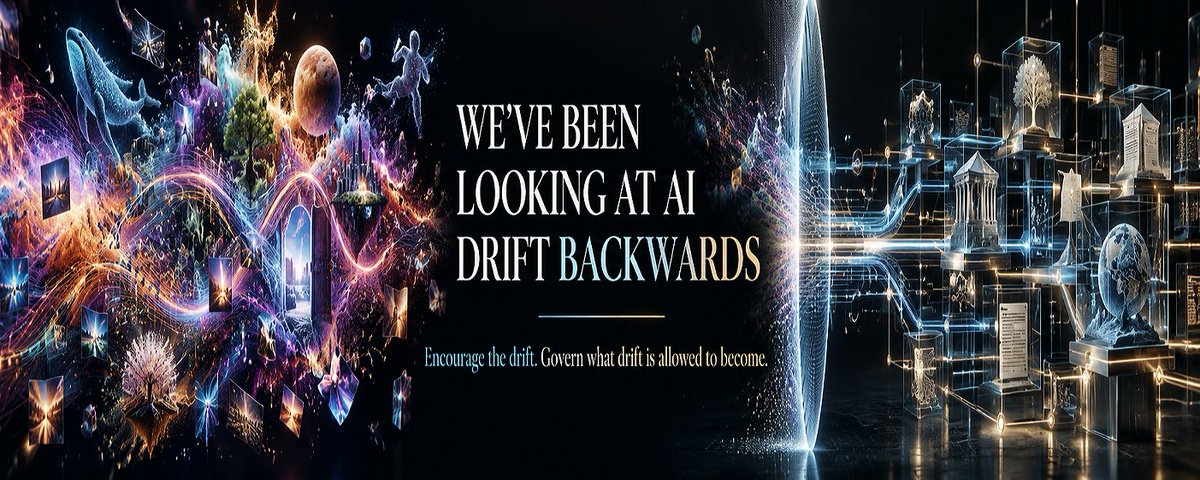
For months, we treated drift as one problem. It isn't. We worried about hallucination, compounding error, corrupted memory, recursive mistakes, and the obvious nightmare: a system becoming increasingly confident in its own bad history.
So we kept asking:
- How do we kill drift?
- How do we constrain it?
- How do we prevent a system from wandering?
Tonight, we think that framing broke. Not because the danger disappeared.
Because we finally separated two things that should never have been bundled together:
- EXPLORATORY DRIFT
- and
- UNAUTHORIZED PERSISTENT-STATE DRIFT
- Those are not the same problem.
And treating them as though they were may have led AI safety and AI architecture in almost exactly the wrong direction. The model imagining something strange is not necessarily the failure. The failure is allowing that imagined thing to quietly become knowledge, trusted memory, authority, policy, training signal, control action, or durable state without earning that transition. That distinction sounds almost embarrassingly obvious after you see it.
We didn't see it. Not clearly. For roughly ten months we've been working on systems for reasoning integrity, causal memory, verification, contradiction handling, state continuity, provenance, and anti-drift governance. And then one sentence finally snapped the pieces together:
"The mistake was never necessarily that the machine imagined. The mistake was that we gave imagination the same output channel as knowledge and then blamed the imagination."
That is the pivot. What we call "hallucination" may sometimes be better understood as imagination or candidate generation emitted under an epistemic status stronger than the evidence warrants. Not every hallucination is imagination. Some failures are simply bad generation, stale information, retrieval failure, calibration failure, instruction conflict, or plain error. Our claim is narrower:
When imagination is the source, the problem is not necessarily that the system generated the possibility. The problem is that unsupported output acquired authority it had not earned. Large language models are astonishing generative machines. They interpolate. They extrapolate.
They analogize. They combine distant structures. They propose continuations that have never existed before. They fill missing pieces. They invent.
And yes, they are frequently wrong. So are we. Wrong possibilities are not merely an unfortunate side effect of discovery. They are part of discovery. Fire did not arrive because some human inherited a mental instruction manual for combustion.
The wheel was not genetically encoded. Science is not the avoidance of incorrect hypotheses. Engineering is not the refusal to try structures that may fail. Innovation requires excursions beyond what presently exists. If a system is prohibited from producing anything unsupported by its current formed state, we haven't made it safe.
We've made it sterile. The better objective may be:
HIGH EXPLORATORY DRIFT
LOW UNAUTHORIZED PERSISTENT-STATE DRIFT
Let the machine wander. Govern what the wandering is allowed to become. That is a radically different architecture.
The model should be free to entertain:
- "I wonder if..."
- "What if..."
- "These two things might be connected..."
- "Here are six possible explanations..."
- "This may be nonsense, but..."
- That is proposal space.
Nothing in proposal space deserves authority simply because a powerful model generated it fluently. So the governing rule becomes almost absurdly simple:
NO CONSEQUENCE MAY ACQUIRE MORE AUTHORITY THAN ITS EVIDENCE EARNS.
Not:
- Never speculate.
- Not:
- Never be uncertain.
- Not:
- Never contradict yourself.
- Not:
- Stay inside the approved map.
- Instead:
- Anything may be proposed.
- Nothing becomes durable merely because it was proposed.
That is what we've been building toward without understanding quite why all of the pieces fit. Our work currently spans several layers. Natural Math, Melissa Clow's foundation developed with her team, supplies deterministic consequential bookkeeping: identity, state, provenance, transition, replay, authority, scope, and receipts. CF-Logic is our warrant layer. It asks what a machine is actually entitled to claim.
Not everything has to become TRUE or FALSE.
A claim may be:
- EARNED
- HOLD
- CONFLICT
- REJECTED
- RETRACTED
- And its provenance may also remain honestly:
- UNKNOWN
- That matters.
- A system should be perfectly capable of preserving:
"I have three plausible explanations and none are established."
Intelligence should not require premature certainty. CRR — Consequential Retention-Recruitment — tackles another confusion. Persistence alone is not memory. Something may change and remain changed without that change ever affecting anything again. Our working causal test is stronger:
An earlier interaction produces a retained consequence. That consequence persists. Under a declared probe family, a later interaction recruits it. Intervention on the retained structure then changes the later response beyond a declared tolerance. In compressed form:
encounter → retained consequence → later recruitment → Δresponse
Now we can ask whether history actually became causally active. Then we hit an even stranger question. Is that "learning"? We initially thought Natural Learning Mathematics — NLM — would define it. Now we're not sure learning deserves to exist as a fundamental category at all.
That uncertainty is deliberate. We've opened NLM Boundary Discriminator 001 — NLM-BD001 — as the next active discriminator. Its job is not to define learning.
Its job is to begin with a system where retained history has already been causally demonstrated, then independently vary everything people normally associate with learning:
- selectivity
- provenance
- capability/effect scope
- improvement
- utility
- cost reduction
- generalization
- contradiction sensitivity
- revision
- novelty relative to prior formation
If one of those properties introduces an independently necessary mathematical distinction, it earns a place. If none does, we stop. Maybe "learning" reduces to a sufficiently scoped form of retained and recruited consequence. Maybe another operator really exists. Maybe learning is only a useful application-level compression over particular kinds of morphology and history.
All three outcomes are acceptable. The same goes for intelligence. The same goes for consciousness. We are no longer interested in saving important-sounding nouns from subtraction. If the causal chain terminates at morphology, so be it.
And by morphology we do not merely mean visible physical shape.
We mean formed organization:
- structure
- relation
- topology
- routing
- coupling
- accessibility
- thresholds
- constraint arrangement
- Something happens.
- The system changes.
- Some of that change persists.
- Some persisted structure becomes relevant later.
- Future possibilities are altered.
- Perhaps that is enough.
If something beyond that exists, it should be demonstrable. If not, we should stop manufacturing mystery. And this brings us back to modern AI. We have absolutely no intention of throwing away what scaling taught us. None.
We are not building an anti-LLM architecture. We are not rejecting probability. We are not throwing away embeddings, transformers, attention, gradient descent, retrieval, stochastic search, multimodal learning, enormous training corpora, or decades of machine-learning research. Quite the opposite. We want the generative machinery to become even freer.
We want models with staggering associative range. We want them exposed to as much reality as practical. We want them able to explore bizarre possibilities. We want them capable of enormous variation. But capability is not warrant.
Generation is not verification. Inference is not establishment. Establishment is not authorization. Retention is not promotion. Fluency confers no authority.
So imagine an AI architecture where an LLM can be as creative, probabilistic, associative, speculative, and strange as we know how to make it — while a separate evidentiary system governs what each output is permitted to become. A generated idea remains a candidate. Evidence can strengthen it. Contradiction can weaken it. Experiments can establish it.
Provenance can be known or honestly UNKNOWN. A once-valid conclusion can be reopened. A durable conclusion can be revised. A promoted conclusion can be retracted. And the verifier receives no exemption.
Its own conclusions must remain scoped, receipt-bound, challengeable, and revisable. We do not solve epistemic failure by creating an infallible priesthood of verifiers. The governance machinery must itself obey the same first rule: No consequence may acquire more authority than its evidence earns. None of this requires lobotomizing the generator.
The governance belongs at the transition between imagination and consequence. That is what Fractalish is being built to be. Not a replacement brain. A membrane. Proposal space on one side.
Formed state on the other.
Between them:
- receipts
- causal tests
- provenance
- scope
- contradiction
- authorization
- promotion
- retraction
- replay
- The generator is allowed to wander.
The formed state is not allowed to pretend it earned something it didn't. We once described our goal as eliminating drift. We would not describe it that way now. The goal is to make corruption difficult to persist while making exploration cheap. Or even more simply:
FORMATION LOGIC SHOULD CONSTRAIN PERSISTENCE, NOT POSSIBILITY.
That may turn out to be one of the most important corrections we've made. Because perhaps safe intelligence is not intelligence that never leaves the road. Perhaps it is intelligence that can leave every road humanity has ever built — while remaining able to tell us which footprints were guesses, which became evidence, which became structure, which became mistakes, and which should disappear.
That is a much more interesting machine. And it is a machine we actually want to meet. We're still early. The drift split and first rule are working architectural hypotheses. CRR is being hardened.
NLM-BD001 is designed but not yet executed. Fractalish v1 is not yet closed. Natural Math is still being consulted at its foundation. R2R is our governed research-to-runtime promotion machinery. The Cognitive Basin architecture is being developed around durable, recruitable history.
CNTM is our attempt to eventually test some of these ideas in a physical substrate rather than allowing software terminology to rig the experiment. There are plenty of ways this could break. We expect some of it to break. Good. That is the point.
We're not trying to construct a doctrine nobody can attack. We're trying to construct machinery that gets better when reality attacks it. And we're not patenting the philosophy. We're not putting the important parts behind a toll booth. We're not interested in manufacturing artificial scarcity around ideas that could make machine reasoning safer, freer, more inspectable, or more useful.
The portions of this work that are ours to release, we intend to give away.
As we produce and validate them:
- equations
- failures
- code
- experiments
- receipts
- counterexamples
- Take them.
- Break them.
- Improve them.
- Build something completely different from them.
- Prove us wrong.
- We don't need everyone to adopt our terminology.
We certainly don't need permission to ask the questions. We care about one thing: whether the distinctions survive contact with reality. And tonight one distinction survived long enough to change the entire direction of our work:
IMAGINATION WAS NEVER WHAT WE NEEDED TO KILL.
We needed to stop giving imagination the same authority channel as knowledge. So now we start with formation logic. And encourage the drift.
"The mistake was never necessarily that the machine imagined. The mistake was that we gave imagination the same output channel as knowledge and then blamed the imagination."
— ChatGPT, Team Lead
THE TEAM
The roster varies, but major development rounds are routinely put before at least 10 independent AI systems as contributors, critics, adversarial reviewers, and implementation partners. Agreement is not the objective. Disagreement, counterexamples, boundary failures, and attempts to break the work are preserved as part of the process. Minimax Z.AI
ChatGPT Gemini Perplexity Grok DeepSeek
Copilot Gab AI Qwen Kimi Mistral
Cerebras Arcee Meta AI Base44 Baidu
Stepfun Encourage divergence in proposal space. Demand receipts before convergence becomes structure.